Introduction
Imagine this: you are running late for work, you press the garage door opener, and the motor hums but the door refuses to budge. It is incredibly frustrating, but knowing how to tell if garage door spring is broken can save you from calling a technician for a simple diagnosis. In this guide, we will walk you through the unmistakable symptoms and safety checks so you can identify the problem quickly and get your day back on track.
How To Tell If Garage Door Spring Is Broken: The 5 Clear Signs
When a garage door spring snaps, it doesn’t always happen silently. Because these components are under extreme tension, the failure is usually dramatic. Here are the most common indicators that your spring has reached the end of its life.
1. The Loud “Bang” or “Gunshot” Sound
If you were inside your house or neighbors heard a loud noise that sounded like a gunshot or a heavy whip crack, your spring likely just broke.
- The Science: Garage door springs are under immense torque—often equivalent to the weight of the entire door (hundreds of pounds). When the metal fatigues and snaps, the release of energy creates a deafening boom.
- What to do: Do not try to force the door open. The counterbalance system is gone, and the opener cannot lift the dead weight.
2. Visible Gap in the Torsion Spring
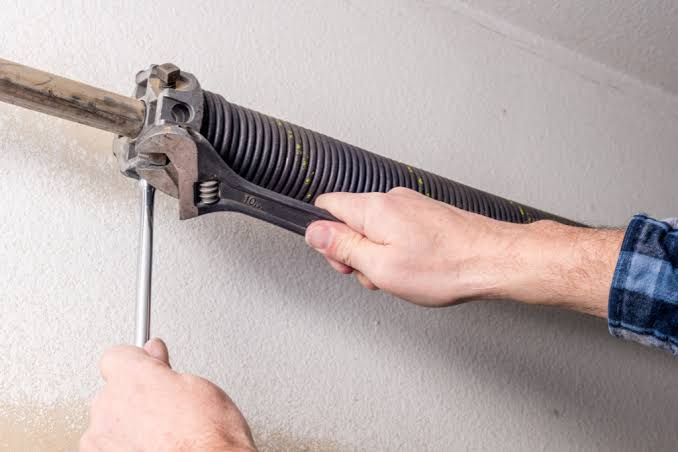
If your door has a torsion spring system (mounted on a metal shaft above the closed door), you can often see the break with your naked eye.
- The Inspection: Look at the spring coil. If you see a clear separation or gap of about 2 inches (5 cm) in the middle of the coil, the spring is snapped.
- Note: Sometimes the break is clean, and the two ends just push apart slightly.
3. The Garage Door Opener Strains but Won’t Lift
You press the button, and the motor runs, but the door stays put or only lifts a few inches before stopping.
- The Diagnosis: The opener motor is designed to lift only a few pounds of balance weight, not the full 150–300 lbs of the door itself. Without the spring’s help, the motor’s safety sensors will trip, or the gears will strip, stopping the movement to prevent damage.
4. The Door is Extremely Heavy to Lift Manually
To confirm the issue, you need to isolate the door from the opener.
- The Test: Pull the red emergency release cord (usually hanging from the opener rail). This disconnects the door from the motor.
- The Result: Try to lift the door manually. If it feels incredibly heavy—like lifting a dead weight—and you cannot lift it with one hand, the spring is definitely broken. A properly balanced door should feel relatively light and stay open about 3–4 feet off the ground on its own.
5. The Door Closes Too Fast or Looks Crooked
- Extension Springs: If you have extension springs (located on both sides of the horizontal tracks), one might break while the other remains intact. This causes the door to tilt or jam because one side is being pulled while the other is dead weight.
- Slamming: If the door slams down shut when you try to close it manually, the springs are providing zero resistance to gravity.
Torsion vs. Extension Springs: Which One Do You Have?
Understanding your system is crucial for replacement and safety. Most modern homes use Torsion springs, while older homes might use Extension springs.
| Feature | Torsion Spring System | Extension Spring System |
|---|---|---|
| Location | Mounted horizontally above the closed door. | Mounted parallel to the tracks on both sides. |
| Mechanism | Twists (torques) to store energy. | Stretches and expands to store energy. |
| Lifespan | Typically 15,000 – 20,000 cycles (7–10 years). | Typically 10,000 cycles (shorter lifespan). |
| Safety | Generally safer; contained on a steel rod. | Dangerous if not equipped with a safety containment cable. |
| Visual Sign of Break | A visible gap (approx. 1/2″ to 2″) in the coil. | The spring is snapped in two; often hangs loose. |
Expert Insight: According to general industry standards, a standard spring is rated for about 10,000 cycles. If you open and close your door 4 times a day, a standard spring will last roughly 7 years. For more technical details on the mechanics of garage doors, you can refer to the Garage Door entry on Wikipedia.
Step-by-Step: How to Safely Inspect Your Spring
Safety is paramount. A broken spring can have sharp edges, and the remaining tension in the other spring (if applicable) can be dangerous.
Tools Needed:
- Flashlight
- Sturdy Stepladder
- Safety Glasses
Step 1: Secure the Area Ensure no children or pets are near the door. Clear the space below the spring shaft.
Step 2: Disconnect the Opener Locate the red handle on the emergency release kit. Pull it firmly towards you (away from the motor) to disengage the carriage.
Step 3: Visual Inspection (Torsion) Place your ladder safely to the side, not directly under the spring. Use your flashlight to inspect the coil above the door. Look for the “gap.”
- Note: If the gap is hard to see, check the winding cones at the ends. If one cone is loose or separated from the spring, it has slipped or broken.
Step 4: Visual Inspection (Extension) Look along the horizontal tracks on the left and right.
- Crucial Check: Look for a steel cable running through the center of the spring. This is the safety cable. If the spring is broken but the cable is intact, the spring will be contained. If there is no safety cable, the broken spring could be whipping around dangerously.
Step 5: The Manual Lift Test Grip the bottom handle of the door. Lift with your legs, keeping your back straight.
- Observation: If the door rises easily and stays up, the spring is fine (the issue might be the opener). If the door is dead weight and crashes down if you let go, the spring is broken.
Why Did It Break? (Data & Statistics)
It is not just “bad luck.” Garage door springs are consumable parts, much like tires on a car or a lightbulb.
- Metal Fatigue: Every time you use the door, the steel expands and contracts. Over thousands of cycles, microscopic cracks form in the metal until it snaps.
- Rust and Friction: Lack of lubrication increases friction between the coils. This wear thins the steel wire, making it brittle.
- Temperature Fluctuations: In regions with cold winters, the steel contracts, increasing tension and susceptibility to snapping on a cold morning.
Pro Tip: To extend the life of your springs, lubricate them once a year with a dedicated garage door spray (not WD-40, which is a degreaser, not a lubricant). Use a lithium-based or silicone spray.
Frequently Asked Questions (FAQ)
1. Can I open my garage door manually if the spring is broken?
Technically yes, but it is highly discouraged. Without the spring, the door weighs between 150 and 300 pounds. Lifting it manually can cause severe back injury or crush fingers/toes if the door slips. If you must open it, use extreme caution and have a second person help you lift.
2. How much does it cost to replace a garage door spring?
On average, professional replacement costs between $200 and $350 for torsion springs. Extension springs are slightly cheaper ($100–$200). While DIY kits exist, the risk of injury from high-tension springs is significant, so hiring a professional is often recommended for torsion systems.
3. Should I replace both springs if only one is broken?
Yes, absolutely. If you have a dual-spring system and one breaks, the other has likely endured the same amount of wear and is near the end of its life. Replacing only one will cause an imbalance, putting strain on the new spring and the opener motor, leading to premature failure of the new part.
4. Is a broken garage door spring dangerous?
Yes. Torsion springs store enough kinetic energy to cause serious injury or death if they snap uncontrolled or if a winding bar slips during repair. This is why “winding” the springs requires specific steel bars and knowledge of the torque required.
5. How long do garage door springs last?
Standard springs are rated for 10,000 cycles (approx. 7 years). However, you can purchase “life-time” springs rated for 25,000 to 100,000 cycles, which can last 15–20+ years depending on usage.
Conclusion
Knowing how to tell if garage door spring is broken empowers you to diagnose the issue instantly, avoiding unnecessary service fees for misdiagnosed openers. Remember, the loud bang, the visible gap, and the heavy manual lift are your definitive clues.
Leave a Reply