Introduction
There are few things more unsettling than pressing your remote and watching your neighbor’s garage door rise instead of your own. If you are currently thinking, “my garage door opener is opening my neighbors garage,” please know that you are not alone, and this is rarely a sign of malicious hacking. This issue typically stems from outdated technology or radio frequency overlap in densely populated neighborhoods.
In this comprehensive guide, we will walk you through exactly why this happens and provide actionable, step-by-step solutions to restore security and peace of mind. We understand how frustrating and awkward this situation can be, but with the right adjustments, you can resolve this conflict quickly and maintain good relations with those living next door.
Why Is My Garage Door Opener Interfering With Nearby Homes?
To solve the problem, we must first understand the root cause. Most garage door openers operate on specific radio frequencies, traditionally 315 MHz or 390 MHz. In older systems using fixed-code technology, the remote sends the same digital code every time. If your neighbor has an identical model with a matching factory-set dip switch configuration, your remote acts as a universal key for their door.
According to industry standards documented on Wikipedia, modern openers utilize rolling code (or hopping code) technology to prevent this exact scenario. However, if you or your neighbor still uses a pre-1996 fixed-code system, signal overlap is almost inevitable in close-quarters housing. Additionally, powerful LED light bulbs installed in garage fixtures can emit electromagnetic interference (EMI) that disrupts signal integrity, causing erratic behavior including unintended activations.
Fixed Code vs. Rolling Code: A Critical Comparison
Understanding your system type is the first diagnostic step. Use this table to identify your technology:
| Feature | Fixed Code (Legacy) | Rolling Code (Modern) |
|---|---|---|
| Security Level | Low (Easily Cloned) | High (Encrypted) |
| Signal Behavior | Static, Repeating Pattern | Dynamic, Changes Every Use |
| Interference Risk | Very High | Extremely Low |
| Manufacture Era | Pre-1996 | Post-1996 to Present |
| Fix Complexity | Requires Full Replacement | Reprogramming/Reset Only |
How Do I Stop My Remote From Opening Other Garage Doors?
If you have confirmed that my garage door opener is opening my neighbors garage, follow this precise 5-step troubleshooting protocol. These steps are ordered from least invasive to most comprehensive.
Step 1: Communicate With Your Neighbor
Before touching any hardware, knock on your neighbor’s door. Explain the situation politely. You need to verify if they are experiencing the reverse issue (their remote opening your door) and determine the age/model of their unit. This collaboration prevents duplicate efforts and maintains community trust.
Step 2: Replace LED Bulbs in Both Garages
Faulty or non-shielded LED bulbs are notorious for broadcasting noise across the 300–400 MHz spectrum.
- Turn off power to the garage door opener.
- Remove existing LEDs and test with a standard incandescent bulb temporarily.
- If interference stops, replace LEDs with RF-shielded garage door opener compatible bulbs (look for FCC Part 15 compliance on the packaging).
- Test both remotes again after replacement.
Step 3: Reset and Reprogram Your Opener
Clearing the memory wipes old conflicting codes.
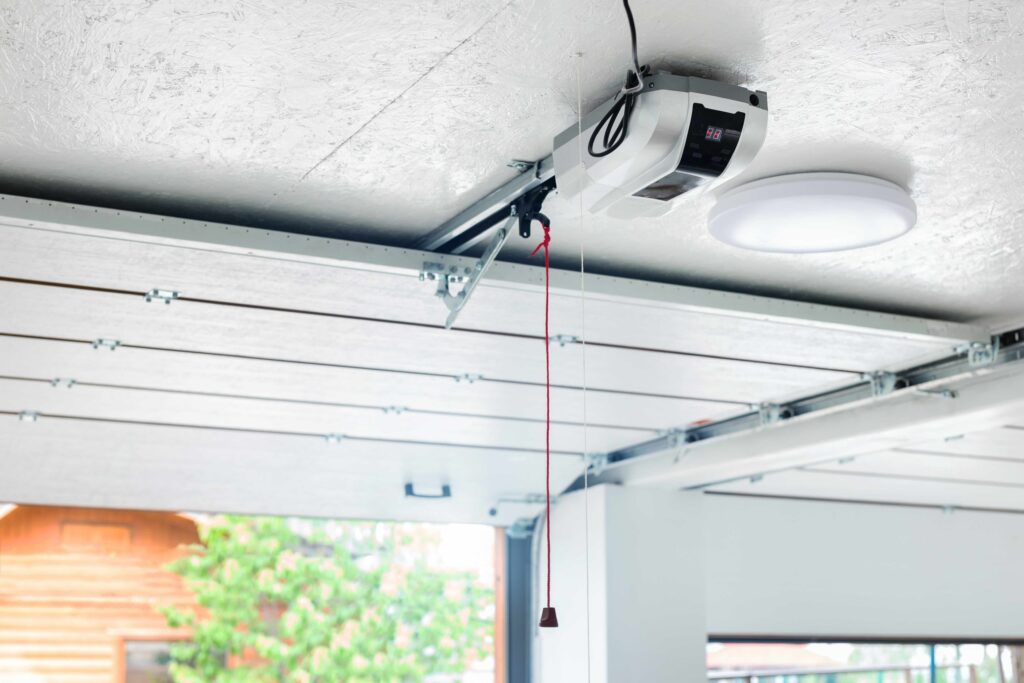
- Locate the “Learn” button on the motor head (usually yellow, purple, or red).
- Press and hold for 10 seconds until the indicator light turns off.
- Release the button; all remotes are now erased.
- Press the Learn button once (light blinks).
- Within 30 seconds, press and hold your remote button until the motor light flashes or clicks.
- Test immediately. Have your neighbor perform the same reset simultaneously to ensure fresh code generation.
Step 4: Adjust Antenna Positioning
The hanging wire antenna on your motor unit may be oriented toward the shared wall.
- Extend the antenna fully downward, perpendicular to the floor.
- Ensure it is at least 6 inches away from metal conduits, rebar, or electrical wiring.
- If possible, relocate the antenna to face away from the neighboring property using an antenna extension kit.
Step 5: Upgrade to Rolling Code Technology
If Steps 1–4 fail, your system is likely obsolete. Upgrading is the only permanent solution for fixed-code units. Modern rolling code openers generate over 100 billion unique code combinations, making accidental neighbor activation statistically impossible. When purchasing, verify the unit operates on dual-frequency bands (310/315/390 MHz auto-select) for optimal resilience against local interference.
Can Weather or Electrical Issues Cause False Activations?
Yes, environmental factors can exacerbate signal problems. While less common than code duplication, these issues deserve attention:
- Lightning Strikes: Nearby strikes can induce voltage spikes in opener circuit boards, corrupting memory and causing phantom activations. Install a surge protector rated specifically for garage door openers.
- Extreme Cold: Below 20°F (-6°C), lubricants thicken and safety sensors misalign, sometimes triggering error cycles that mimic interference. Apply white lithium grease to moving parts seasonally.
- Power Grid Fluctuations: Brownouts can reset opener logic boards to factory defaults. If your neighborhood experiences frequent voltage dips, a UPS backup for the opener preserves custom settings.
Frequently Asked Questions (FAQ)
1. Is it illegal if my garage door opener opens my neighbor’s garage?
No, it is not illegal if the interference is unintentional and caused by equipment malfunction or obsolescence. However, you have a responsibility to mitigate the issue once identified. Continuing to use known-interfering equipment after notification could potentially lead to civil liability if damage or security breaches occur. Always document your repair attempts.
2. Will changing the batteries in my remote fix the interference?
Rarely. Weak batteries reduce signal range but do not alter the transmitted code. If my garage door opener is opening my neighbors garage due to fixed-code duplication, fresh batteries will not resolve the conflict. Battery replacement is still recommended as part of general maintenance, but expect to proceed with reprogramming or hardware upgrades for actual interference resolution.
3. How often should I reprogram my garage door opener to prevent conflicts?
For rolling code systems, annual reprogramming is unnecessary unless you experience issues. For legacy fixed-code systems, reprogramming every 6 months reduces (but does not eliminate) collision risk. The better long-term strategy is upgrading to rolling code technology, which eliminates scheduled maintenance for interference prevention entirely.
4. Can smart garage door controllers cause neighbor interference?
Smart controllers (Wi-Fi/Z-Wave enabled) actually reduce RF interference risk because they use encrypted digital protocols separate from traditional 315/390 MHz bands. However, poorly designed aftermarket smart adapters can introduce new EMI. Always choose UL-listed smart controllers with FCC certification, and avoid unbranded devices sold on third-party marketplaces lacking proper shielding.
5. What if my neighbor refuses to cooperate or upgrade their system?
Document all communication attempts and your own remediation efforts. Contact your homeowner’s association (HOA) if applicable, as many have covenants requiring functional, non-interfering equipment. As a last resort, consult a licensed garage door technician who can install a frequency filter or directional antenna on your system to isolate your signal regardless of neighboring equipment status. Professional installation typically costs between $150–$300.
6. Does homeowner’s insurance cover damages from garage door interference?
Coverage varies significantly by policy. Most standard policies exclude mechanical/electrical malfunction but may cover resulting theft or property damage if negligence is proven. Review your policy’s “personal property” and “liability” sections. Proactively fixing known interference issues strengthens your position should a claim ever arise. Keep receipts for all repairs and upgrades as evidence of due diligence.
Conclusion
Discovering that my garage door opener is opening my neighbors garage is undoubtedly stressful, but it is a solvable technical challenge rather than a security catastrophe. By systematically diagnosing your system type, eliminating EMI sources, reprogramming codes, and upgrading to rolling code technology when necessary, you can permanently resolve this issue. Remember that open communication with your neighbor transforms an awkward problem into a collaborative solution that benefits both households.
Your home’s security and your neighborhood relationships are worth the investment of time and resources. Don’t let this issue linger—take action today using the steps outlined above.
Leave a Reply