Introduction
There are few things more stressful than hearing a loud bang from your garage and realizing your door is stuck halfway open. If you are searching for how to close a garage door with a broken spring, you are likely dealing with an urgent security or weather-related issue right now. We understand the panic this causes, but please prioritize safety above all else; a door without spring tension is deceptively heavy and dangerous. This guide will walk you through the safest emergency procedures to secure your home without risking severe injury.
Understanding Why Your Garage Door Won’t Stay Closed
Before attempting any manual intervention, it is vital to understand the mechanics at play. Garage doors typically weigh between 150 and 400 pounds. The springs (either torsion or extension) act as a counterbalance system, offsetting roughly 90% of that weight. When a spring snaps, that entire load transfers instantly to the door itself and the opener mechanism.
Attempting to force the door down without understanding this weight transfer is the leading cause of DIY garage injuries. According to the U.S. Consumer Product Safety Commission (CPSC), thousands of emergency room visits annually are attributed to garage door accidents, many involving unbalanced doors. Recognizing the type of spring failure helps determine if manual closure is even feasible for your specific situation. For a deeper technical understanding of these counterbalance mechanisms, you can refer to the Garage Door Wikipedia Entry, which details the physics behind torsion and extension systems.
Critical Safety Warnings Before You Begin
STOP. Read this section before touching the door. If you cannot safely adhere to these warnings, skip to the “When to Call a Professional” section.
- Never Disconnect the Opener While the Door is Open: If the door is currently raised, disconnecting the trolley could cause the door to crash down instantly due to lack of counterbalance.
- Wear Protective Gear: Safety glasses and heavy-duty work gloves are non-negotiable. Steel cables can fray and snap under uneven tension.
- Clear the Area: Ensure no children, pets, or bystanders are within 10 feet of the door’s path.
- Two-Person Minimum: Never attempt to manually lower a dead-weight garage door alone. You need one person to stabilize each side.
- Check Cable Integrity: If the lifting cable is also frayed, snapped, or off the drum, do not touch the door. The structural integrity is compromised, and the door could collapse sideways.
Step-by-Step: How To Close A Garage Door With A Broken Spring
If you have assessed the risks and determined it is safe to proceed, follow this precise method. This process assumes the door is currently in the open or partially open position and you need to secure it for the night.
1. Gather Your Equipment
Preparation prevents panic. Have these items ready before starting:
- Two sturdy C-clamps or locking pliers (Vise-Grips)
- Heavy-duty work gloves
- Safety glasses
- A helper (mandatory)
- Stepladder (if clamping high on the track)
2. Secure the Door in Its Current Position
Before releasing any tension or disconnecting anything, clamp the door tracks just below the bottom rollers on both sides. This acts as a temporary brake, preventing accidental free-fall while you prepare. Tighten the C-clamps firmly against the track metal.
3. Release the Opener Tension
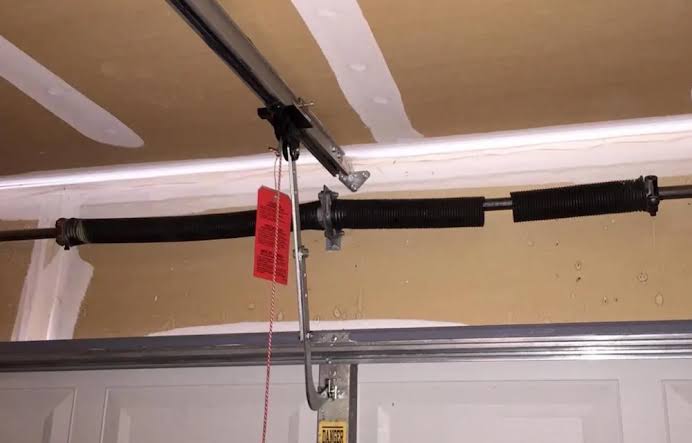
Locate the emergency release cord (usually red) hanging from the opener rail. Pull it straight down to disengage the trolley from the carriage. Do not pull at an angle. Once released, the opener motor will no longer hold or assist the door. The C-clamps installed in Step 2 are now the only thing holding the door up.
4. Controlled Descent Technique
This is the most critical phase. With your helper positioned on the opposite side:
- Both persons should grip the bottom edge of the door firmly, palms facing up.
- Simultaneously loosen the C-clamps just enough to allow movement, but keep them in place as sliding safety stops.
- Lower the door in increments of no more than 6 inches at a time.
- After each 6-inch descent, re-tighten the clamps to rest and reassess grip.
- Communicate constantly: “Lowering,” “Stopping,” “Clamping.”
- Continue until the door rests fully on the floor.
5. Lock the Door Immediately
Once closed, the door has zero counterbalance and can be lifted easily from outside by intruders. Engage the manual slide lock or install a padlock through the track holes immediately. Do not leave an unbalanced door unlocked, even for minutes.
Pros vs. Cons: Manual Closure vs. Professional Help
Deciding whether to proceed requires honest self-assessment. Use this comparison table to evaluate your situation:
| Factor | DIY Manual Closure | Hiring a Professional |
|---|---|---|
| Cost | $0 (assuming tools owned) | $150–$350 average service call |
| Time Investment | 1–3 hours (high stress) | 45–90 minutes (expert efficiency) |
| Safety Risk | High (crush/fall hazard) | Minimal (trained & insured) |
| Warranty Impact | May void opener warranty | Preserves all warranties |
| Long-Term Fix | Temporary only | Permanent repair + inspection |
| Best For | True emergencies, experienced DIYers | Most homeowners, peace of mind |
Expert Insight: Mike Reynolds, a certified garage door technician with 22 years of experience, notes: “I’ve repaired countless doors damaged by well-meaning homeowners who tried to ‘just get it closed.’ The cost of fixing bent tracks and shattered panels often triples what a spring replacement would have cost initially. If you’re unsure, waiting 12 hours for a pro is cheaper than a hospital visit.”
Signs You Should NOT Attempt Manual Closure
Abandon the DIY approach immediately if you observe any of the following:
- Door is crooked or tilted in the tracks
- Visible gap between roller and track exceeding ¼ inch
- Cable is wrapped unevenly around the drum
- Spring fragments are lodged in the track
- You feel resistance that doesn’t match expected weight
- Any unusual grinding/scraping sounds during test movement
These indicate structural damage beyond simple spring failure. Forcing closure will compound damage exponentially.
FAQ Section
Q1: Can I use my garage door opener to close the door if the spring is broken?
No. Operating an opener with a broken spring puts extreme strain on the motor and gear assembly. Most openers have torque sensors that will reverse the door when they detect abnormal resistance, but repeated attempts can burn out the motor or strip gears permanently. Always use manual methods for emergency closure only.
Q2: How long can I leave my garage door closed with a broken spring?
You can leave it closed indefinitely, but do not attempt to reopen it until the spring is replaced. The door is essentially dead weight. Leaving it closed is actually safer than leaving it partially open, as partial positions create unpredictable tension points. Schedule repair within 24–48 hours to restore normal function.
Q3: Will closing the door manually damage the opener?
Not if done correctly. The key is pulling the emergency release before applying manual force. Damage occurs when people try to force the door while still connected to the trolley, bending the carriage arm or damaging the rail alignment. Always disconnect first, then move manually.
Q4: How much does garage door spring replacement typically cost?
National averages range from $200 to $400 for torsion spring replacement, including parts and labor. Extension springs are generally less expensive ($150–$300). Prices vary based on spring size, door weight, and regional labor rates. Always replace springs in pairs—even if only one broke—to ensure balanced tension and prevent premature failure of the remaining spring.
Q5: Is it illegal to repair garage door springs myself?
No federal or state laws prohibit DIY spring repair. However, many manufacturers’ warranties explicitly exclude damage caused by unlicensed repairs. More importantly, torsion springs store lethal amounts of kinetic energy; improper handling has caused fatalities. Professional certification exists for good reason.
Q6: What temporary measures can secure my garage overnight?
Beyond manual closure and locking, consider: installing a temporary hasp and padlock through the track, placing a wooden 2×4 brace diagonally from floor to door panel, or using a garage door defender ground anchor. These buy time until professional repair. Never rely solely on the opener’s internal lock mechanism with a broken spring—it’s designed for balanced doors only.
Conclusion
Knowing how to close a garage door with a broken spring is valuable emergency knowledge, but it should never replace professional repair. The steps outlined here prioritize your safety over convenience, because no amount of saved money justifies risking crush injuries or property damage. Remember: this manual closure is a temporary stopgap, not a solution.
We hope this guide helped you secure your home safely tonight. If you found this information useful, please share it on social media to help other homeowners avoid dangerous mistakes. Tag someone who might need this emergency guidance—you could prevent a serious accident. Stay safe, and don’t hesitate to call a certified technician when in doubt. Your family’s safety is worth far more than a service call fee.
Leave a Reply