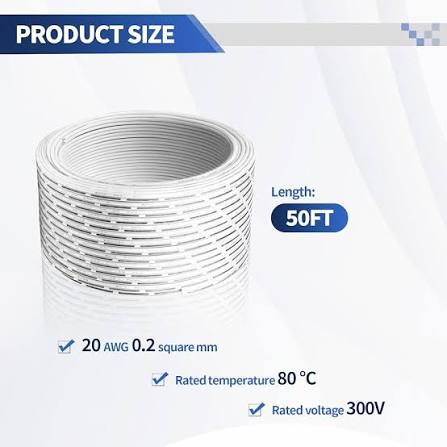
Have you ever stood in your garage, holding a spool of leftover wire, wondering if it will work for your new garage door opener installation? It is a common dilemma for DIY enthusiasts who want to save money or use what they have on hand. The question “Can I Use 20 Gauge Wire For Garage Door Opener“ is one of the most frequent queries we see from homeowners trying to balance convenience with technical requirements. While it might seem like any wire will do, using the wrong gauge can lead to frustrating malfunctions or even safety hazards. Let’s dive into the details to ensure your garage door operates smoothly and safely.
Understanding Wire Gauge and Garage Door Systems
To answer whether 20-gauge wire is suitable, we first need to understand what “gauge” means in the context of electrical wiring. The American Wire Gauge (AWG) system measures the diameter of the wire. Here is the golden rule: the higher the gauge number, the thinner the wire.
Garage door openers typically operate on low-voltage circuits for their safety sensors and wall control buttons. Most manufacturers specify the use of 22-gauge to 18-gauge stranded wire.
- 18-Gauge Wire: Thicker, carries more current over longer distances with less resistance.
- 20-Gauge Wire: Thinner than 18-gauge but thicker than 22-gauge.
- 22-Gauge Wire: The industry standard for most short-run sensor connections.
So, where does 20-gauge fit in? It sits right in the middle. But is it recommended? That depends on several factors, including distance and the specific requirements of your opener model.
Why Wire Thickness Matters
Electricity faces resistance as it travels through a wire. Thinner wires (higher gauge numbers) have higher resistance. If the resistance is too high, the voltage drops before it reaches the component. For garage door sensors, which require a steady, low-voltage signal (usually 5–12 volts), excessive voltage drop can cause the door to reverse unexpectedly or fail to close entirely.
Can I Use 20 Gauge Wire For Garage Door Opener Sensors?
The short answer is: Yes, in many cases, you can use 20-gauge wire for garage door opener sensors, but it is not always the best choice.
Most major brands like LiftMaster, Chamberlain, and Genie recommend 22-gauge stranded wire for connecting the safety eyes (sensors) to the motor unit. Since 20-gauge wire is actually thicker than 22-gauge, it has less resistance. Therefore, electrically speaking, it is capable of carrying the necessary current without significant voltage drop, especially for typical residential garage sizes.
When 20-Gauge Wire Is Acceptable
You can confidently use 20-gauge wire if:
- The Run Is Short: If the distance between the motor unit and the sensors is under 20–30 feet, 20-gauge wire will perform excellently.
- It Is Stranded Wire: Ensure the wire is stranded, not solid core. Stranded wire is more flexible and resistant to breaking from vibration, which is crucial in a garage environment.
- The Manufacturer Does Not Explicitly Forbid It: Check your manual. Some high-end models with advanced diagnostic features may be sensitive to wire impedance.
When to Avoid 20-Gauge Wire
Avoid using 20-gauge wire if:
- You Have a Very Large Garage: If the wire run exceeds 50 feet, the added resistance of thinner wire (compared to 18-gauge) might become an issue, although 20-gauge is still better than 22-gauge here.
- You Are Wiring the Wall Control Panel: Some wall consoles require slightly more power for backlit buttons or LCD screens. In these cases, sticking to the manufacturer’s recommendation (often 22-gauge or 18-gauge) is safer.
Comparison: 18-Gauge vs. 20-Gauge vs. 22-Gauge Wire
To help you make an informed decision, here is a quick comparison of the most common wire gauges used in garage door installations.
| Feature | 18-Gauge Wire | 20-Gauge Wire | 22-Gauge Wire |
|---|---|---|---|
| Thickness | Thickest | Medium | Thinnest |
| Resistance | Lowest | Moderate | Highest |
| Flexibility | Less Flexible | Moderately Flexible | Highly Flexible |
| Best For | Long runs (>50 ft), heavy-duty use | Medium runs, general purpose | Standard sensor kits (<30 ft) |
| Cost | Slightly Higher | Moderate | Lowest |
| Ease of Use | Harder to strip/connect | Easy to handle | Very easy to handle |
Key Takeaway: While 22-gauge is the standard “kit” wire, 20-gauge is a robust alternative that offers a good balance of durability and conductivity. It is certainly superior to using anything thinner, like 24-gauge telephone wire, which is often too thin and prone to breakage.
Step-by-Step: How to Wire Your Garage Door Opener with 20-Gauge Wire
If you decide to proceed with 20-gauge wire, follow these steps to ensure a secure and functional connection.
Step 1: Gather Your Materials
- 20-gauge stranded wire (two-conductor is ideal).
- Wire strippers.
- Screwdriver set.
- Electrical tape or wire nuts (if splicing is needed).
Step 2: Turn Off the Power
Safety first! Unplug your garage door opener or turn off the circuit breaker to prevent any accidental activation while you are working.
Step 3: Measure and Cut the Wire
Measure the distance from the motor unit to the sensor location. Add an extra 2–3 feet for slack and routing around obstacles. Cut two lengths of wire if you are running separate pairs for each sensor, or one long continuous run if daisy-chaining (check your manual for wiring topology).
Step 4: Strip the Ends
Use your wire strippers to remove about 1/2 inch (1.27 cm) of insulation from both ends of the wire. Be careful not to nick the copper strands, as this can weaken the wire.
Step 5: Connect to the Motor Unit
Locate the terminal block on your garage door opener motor. It is usually labeled “SENSOR” or “SAFETY EYE.”
- Connect one wire to the white terminal.
- Connect the other wire to the grey (or black) terminal.
- Tighten the screws securely.
Step 6: Connect to the Sensors
Run the wire to the receiving sensor (the one with the LED light). Connect the wires to the corresponding terminals. Ensure the polarity matches if specified by your manufacturer (though most modern sensors are non-polarized). Repeat for the sending sensor if required.
Step 7: Test the System
Plug the opener back in. Align the sensors so that the LED lights are solid (not blinking). Try closing the door. If the door closes and reverses when you break the beam, your wiring is successful.
Expert Insight: What Do Professionals Say?
According to general electrical principles and guidelines from organizations like the National Electrical Code (NEC), low-voltage wiring does not have the same strict gauge requirements as high-voltage household wiring. However, professionals emphasize reliability.
Many seasoned garage door technicians prefer 18-gauge or 20-gauge stranded wire over the flimsy 22-gauge wire included in kits because it is more durable during installation and less likely to suffer from corrosion or breakage over time. As one industry expert notes, “Using a slightly thicker wire like 20-gauge provides a margin of safety against voltage drop and physical damage, making it a smart choice for DIYers who want a long-lasting install.”
FAQ Section
1. Can I use solid core 20-gauge wire instead of stranded?
It is not recommended. Solid core wire is brittle and can break easily due to the vibrations caused by the garage door opener motor. Stranded wire is flexible and absorbs vibration, making it much more reliable for this application.
2. Will using 20-gauge wire void my warranty?
Generally, no. Most manufacturers specify a minimum gauge (e.g., “use 22-gauge or thicker”). Since 20-gauge is thicker than 22-gauge, it meets the requirement. However, always check your specific owner’s manual to be sure.
3. Can I use old telephone wire (24-gauge) for my garage door?
No. Telephone wire is typically 24-gauge or 26-gauge, which is too thin. It has high resistance and is very fragile. Using it can lead to signal loss, causing your garage door to malfunction or fail to close.
4. Does the color of the wire matter?
No, the color of the insulation does not affect performance. However, using two different colors (e.g., red and black) can help you keep track of polarity if your system requires it. Most modern garage door sensors are non-polarized, meaning either wire can go to either terminal.
5. What if my garage door opener still doesn’t work with 20-gauge wire?
If you have wired it correctly and the door still malfunctions, check the following:
- Ensure the sensors are perfectly aligned.
- Check for loose connections at the terminals.
- Verify that the wire is not pinched or damaged.
- Consult the troubleshooting section of your manual, as the issue may lie with the motor unit or sensors themselves, not the wire.
Conclusion
So, can I use 20 gauge wire for garage door opener? Yes, you absolutely can. In fact, using 20-gauge stranded wire is often a better choice than the standard 22-gauge wire provided in kits, especially if you want greater durability and lower resistance. It strikes a perfect balance between ease of handling and electrical efficiency for most residential garages.
By choosing the right wire and following proper installation steps, you ensure your garage door operates safely and reliably for years to come. Remember, the goal is not just to get the door working today, but to keep it working tomorrow.
Did you find this guide helpful? Share it with your friends or neighbors who are tackling their own DIY garage projects! Let’s help everyone keep their garages safe and functional.
Leave a Reply