Introduction
It is a stressful moment every homeowner dreads: you press the button to leave for work, the motor hums, but the door refuses to budge—or perhaps it only lifts a few inches before stopping. If you are currently staring at a stuck door and asking, “Will a garage door open with a broken spring?” you are not alone. While the short answer is that the door can be moved manually, relying on the automatic opener is dangerous and likely to cause further damage. This guide will walk you through the mechanics, the risks, and the safe steps to handle a broken spring situation.
The Short Answer: Can It Open?
Technically, yes, a garage door can be opened with a broken spring, but not with the automatic opener.
The springs on your garage door are responsible for counterbalancing the weight of the door. A standard single-car garage door can weigh anywhere from 150 to 300 pounds, while a double-car door can exceed 400 pounds. The opener motor is designed to lift this weight with the assistance of the springs. Without that assistance, the motor is essentially trying to lift dead weight.
If you attempt to use the opener, you risk:
- Burning out the motor: The strain can permanently damage the opener.
- Stripping the gears: The internal cogs of the opener may snap under the pressure.
- Snapping cables: The remaining tension (if one spring broke on a dual-spring system) can cause cables to fray or snap.
Understanding the Mechanics: Torsion vs. Extension Springs
To understand why the door is stuck, you need to identify which type of spring system you have. This distinction affects how the door behaves when a break occurs.
| Feature | Torsion Springs | Extension Springs |
|---|---|---|
| Location | Mounted horizontally above the closed door. | Mounted parallel to the ceiling tracks on both sides. |
| Mechanism | They twist (torque) to store energy. | They stretch to store energy. |
| Safety Risk | High. They are under extreme tension and can cause severe injury if they snap violently. | Moderate. They often have a safety containment cable running through them to prevent flying debris. |
| Visual Sign | You will see a visible gap (about 1-2 inches) in the coil where the metal snapped. | The spring will appear stretched out or completely separated. |
Note: According to industry standards, springs are rated by “cycles” (one open + one close). A standard spring is rated for 10,000 cycles, which typically translates to 5–7 years of use.
The Dangers of Forcing the Door
Many homeowners attempt to “help” the opener by pulling the door up while pressing the button. Do not do this.
When a spring breaks, the door becomes a heavy, unbalanced object. If you force it, you compromise the structural integrity of the hinges, rollers, and tracks. Furthermore, if you have a torsion spring system, a broken spring can sometimes cause the torsion tube to spin violently, potentially loosening the set screws and creating a hazardous situation.
For more detailed technical background on the components of a garage door system, you can refer to the Garage Door Wikipedia page, which outlines the evolution and safety standards of these mechanisms.
Step-by-Step: How to Manually Open the Door (Safely)
If you absolutely must get your car out and cannot wait for a professional, you can manually lift the door. However, you must treat the door as if it weighs 400 pounds.
Warning: If your door is already partially open, do not attempt to close it manually without locking the tracks. It could slam down unexpectedly.
Step 1: Disengage the Opener
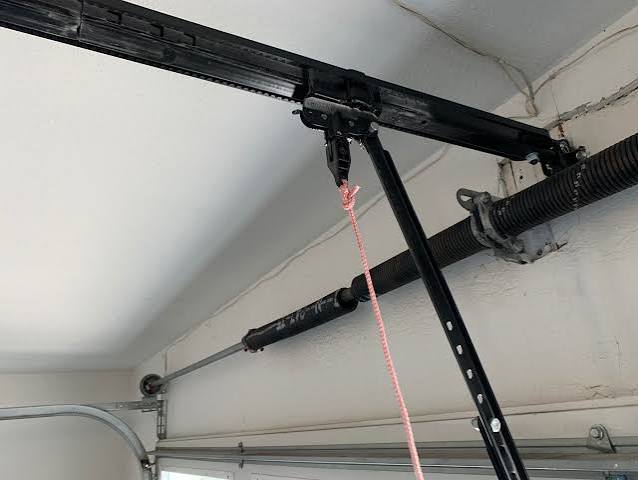
Locate the emergency release cord (usually red with a handle) hanging from the opener carriage. Pull this cord firmly down and away from the motor. This disconnects the door from the motor chain/belt.
- Detail: You should hear a distinct “click” as the carriage releases.
Step 2: Secure the Door (Crucial Safety Step)
Before lifting, if possible, place C-clamps or locking pliers on the tracks just below the bottom roller on both sides.
- Why? If the door is heavy and slips from your hands, or if the other spring (on a dual system) snaps, the clamps will prevent the door from crushing your vehicle or feet.
Step 3: The Lift
Stand squarely in front of the door. Use both hands to grip the bottom handle or the bottom edge of the door.
- Lift slowly and smoothly.
- Do not jerk the door.
- Once the door passes the halfway point, it may try to slam shut or fly open depending on the remaining balance. Be prepared to support the weight.
- Once fully open, secure it with a vice grip on the track or a clamp to prevent it from falling.
Step 4: Re-engaging the Opener
When you return, you will need to pull the release cord again (towards the motor) to reconnect the carriage to the drive mechanism.
Signs Your Spring is Broken
Sometimes it isn’t obvious. Here are the tell-tale signs that you are dealing with a broken spring:
- The “Bang” Sound: A broken spring sounds like a gunshot or a loud explosion. If you heard this inside your garage, it’s almost certainly the spring.
- Gap in the Spring: Inspect the torsion spring above the door. If you see a clear gap (separation) in the metal coil, it is broken.
- Crooked Door: If the door lifts unevenly (one side higher than the other), the spring on the higher side may be intact while the other is broken, or a cable has slipped.
- Heavy Lifting: If you disengage the opener and the door is incredibly heavy to lift manually, the springs have lost their tension.
Repair vs. Replacement: What Should You Do?
Once you have confirmed the spring is broken, you need to decide on the fix.
- DIY Repair?
- Pros: Saves money on labor ($150–$200).
- Cons: Extremely dangerous. Torsion springs store enough kinetic energy to break bones or cause fatal injuries if handled incorrectly.
- Verdict: Only recommended for those with advanced mechanical skills and proper winding bars.
- Professional Replacement?
- Pros: Safety guaranteed, includes warranty, correct calibration.
- Cons: Higher upfront cost ($250–$400 depending on region).
- Verdict: Highly Recommended.
Pro Tip: If you have two springs and only one broke, replace both. They were installed at the same time; if one failed, the other is near the end of its lifecycle. Replacing both saves you a second service call fee in six months.
FAQ Section
1. How much does it cost to replace a garage door spring?
On average, homeowners in the US can expect to pay between $200 and $350 for professional spring replacement. This includes parts and labor. Torsion springs are generally more expensive to replace than extension springs due to the complexity and risk involved.
2. Can I drive my car out if the spring is broken?
Yes, but you must manually lift the door. As detailed in the steps above, disengage the opener, use clamps for safety, and lift with your legs, not your back. Be prepared for the door to feel incredibly heavy.
3. How long do garage door springs last?
Standard springs are rated for 10,000 cycles. If you open and close your door 4 times a day, the springs should last roughly 7 years. If you use your door more frequently, ask your technician for “life-cycle” rated springs that can last up to 20,000 or 30,000 cycles.
4. Is it dangerous to fix a broken spring myself?
Yes. Torsion springs are under extreme tension. Improper use of winding bars can lead to the bar slipping, causing the spring to unwind violently. This can result in severe lacerations, broken fingers, or head injuries. Unless you are experienced, hire a professional.
5. Why did my spring break?
The most common cause is simply wear and tear (metal fatigue). However, lack of lubrication, rust, or a misaligned door can put extra stress on the spring, causing it to fail prematurely.
Conclusion
Dealing with a broken garage door spring is a major inconvenience, but understanding will a garage door open with a broken spring helps you make safe decisions. While the door can be moved manually, the risks to your property and personal safety are high. The automatic opener is not designed to lift the door without spring assistance.
If you suspect a broken spring, prioritize safety: disengage the opener, secure the door, and call a certified technician.
Leave a Reply