Introduction
There is nothing quite as frustrating as rushing out the door in the morning, pressing your remote, and hearing… silence. Or worse, hearing the motor hum but seeing the door stay firmly shut. If your Liftmaster garage door opener will not open or close, you are likely feeling a mix of anxiety and inconvenience. You are not alone; this is one of the most common household maintenance issues faced by American homeowners.
Before you call an expensive technician, take a deep breath. In many cases, the issue is not a broken motor but a simple sensor misalignment, a locked control panel, or a power surge glitch. This guide will walk you through professional-grade troubleshooting steps to diagnose and fix the problem safely and efficiently.
1. Is the Power Source Actually Working?
It sounds obvious, but it is the most frequently overlooked cause of failure. Before diving into complex mechanical diagnostics, we must verify the basics.
Check the Outlet Ensure the opener unit is plugged in securely. Sometimes, vibrations from the door’s movement can loosen the plug over time. Try plugging a lamp or phone charger into the same outlet to confirm it has power. If the outlet is dead, check your home’s circuit breaker box. Look for a tripped breaker labeled “Garage” or “Opener.” Reset it by flipping it fully off and then back on.
Inspect the Power Cord Look for any visible damage to the power cord, such as fraying or bite marks from pests. A compromised cord can interrupt power flow even if the plug seems secure.
Pro Tip: If your Liftmaster model has a battery backup (common in newer Wi-Fi enabled models), ensure the backup battery is charged. A failing battery can sometimes cause erratic behavior even when plugged in.
2. Are the Safety Sensors Aligned and Clean?
Modern garage doors are equipped with photo-eye sensors near the floor on both sides of the door. These are critical safety features mandated by federal law. If these sensors are blocked, misaligned, or dirty, the door will refuse to close—and often refuse to open—as a safety precaution.
How to Diagnose Sensor Issues:
- Look at the LED Lights: One sensor should have a green light (power), and the other should have an amber or red light (beam alignment). If either light is blinking or off, there is an issue.
- Check for Obstructions: Spider webs, leaves, or dirt can block the invisible beam. Wipe the lenses gently with a soft, dry cloth.
- Verify Alignment: The sensors must face each other directly. If one has been bumped by a car or lawn mower, the beam is broken. Loosen the wing nut, adjust the bracket until the lights turn solid, and tighten it back.
According to safety standards outlined by consumer protection agencies, the door must reverse if the beam is interrupted. For more details on federal safety requirements for garage doors, you can refer to the Consumer Product Safety Commission guidelines.
3. Is the Wall Control Panel Locked?
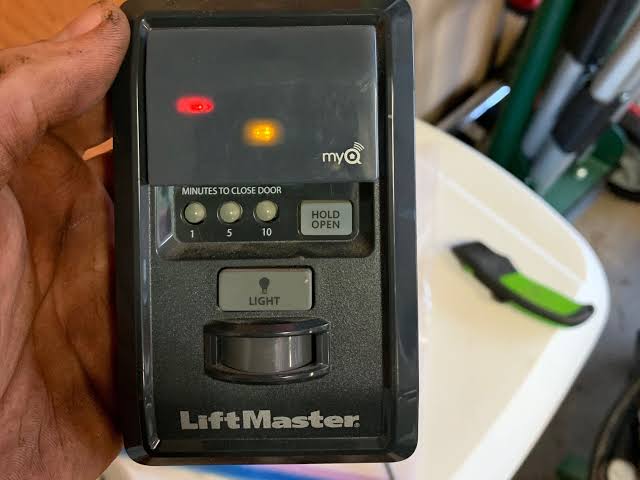
Many homeowners accidentally lock their garage door opener via the wall-mounted control panel. This feature is designed to prevent children or unauthorized users from operating the door.
The Lock Button Look for a button on your wall console labeled “Lock,” “Secure,” or represented by a padlock icon. If this feature is activated, the remote controls and keypad will be disabled, though the wall button itself may still work. Press and hold the lock button for 2–3 seconds to deactivate it. You should hear a beep or see a light flash indicating the lock is disengaged.
Child Lock Feature Some newer Liftmaster models have a “Child Lock” feature accessible via the MyQ app. Check your smartphone app to ensure this digital lock hasn’t been inadvertently turned on.
4. Have You Tried Reprogramming the Remote?
Sometimes, the issue isn’t the opener itself, but the communication link between your remote and the motor unit. Signal interference from nearby electronics, LED bulbs, or even neighbors’ devices can disrupt this connection.
Step-by-Step Reprogramming:
- Locate the “Learn” button on your Liftmaster motor unit. It is usually colored yellow, purple, orange, or red, located near the hanging antenna wire.
- Press and release the Learn button. The indicator light will turn on or blink.
- Within 30 seconds, press and hold the button on your remote that you wish to program.
- Release the button when the motor unit’s lights blink or you hear two clicks.
- Test the remote.
If you have multiple remotes, repeat this process for each one. If none of them work after reprogramming, the issue likely lies with the motor unit’s receiver board.
5. Is the Manual Lock Engaged?
Older garage doors or specific models may have a manual slide lock or a T-handle lock on the door itself. This is a physical bar that slides into a track to prevent the door from moving.
Check the Door Tracks Walk up to the door and look at the vertical tracks on either side. Is there a metal bar engaged? If so, slide it back to the unlocked position. Additionally, check if the emergency release cord (the red rope hanging from the trolley) has been pulled. If the release cord is pulled, the door is disconnected from the opener. To reconnect it, simply lift the door slightly and push the trolley arm back into place until it clicks.
6. Are the Travel Limits Set Correctly?
The travel limits tell the opener how far to go up and how far to go down. If these settings drift due to temperature changes or wear, the door may stop prematurely or reverse immediately after hitting the floor.
Adjusting Travel Limits:
- Down Limit: If the door hits the ground and reverses, the down limit is set too far. Turn the down limit adjustment screw (usually marked with a down arrow) in small increments (1/8th of a turn) until the door closes fully without reversing.
- Up Limit: If the door doesn’t open all the way, adjust the up limit screw similarly.
Note: Always make small adjustments. Over-adjusting can cause the door to strain against the stops, damaging the gears.
7. Could It Be a Broken Spring or Cable?
If the motor runs but the door does not move, or if it moves very slowly and struggles, the issue may be mechanical rather than electrical. Garage doors are heavy, and the springs do the heavy lifting.
Warning Signs of Mechanical Failure:
- A loud “bang” noise from the garage.
- Visible gaps in the torsion spring above the door.
- Cables that appear loose or frayed.
Safety Alert: Never attempt to repair or replace garage door springs yourself. These springs are under extreme tension and can cause severe injury or death if they snap during repair. If you suspect a broken spring or cable, contact a licensed professional immediately.
Comparison: DIY Fixes vs. Professional Help
| Issue | DIY Friendly? | Risk Level | Estimated Cost |
|---|---|---|---|
| Tripped Breaker | ✅ Yes | Low | $0 |
| Misaligned Sensors | ✅ Yes | Low | $0 |
| Remote Reprogramming | ✅ Yes | Low | $0 |
| Locked Control Panel | ✅ Yes | Low | $0 |
| Broken Spring | ❌ No | High | $150–$350 |
| Stripped Gears | ❌ No | Medium | $200–$400 |
| Circuit Board Failure | ❌ No | Medium | $100–$250 |
Frequently Asked Questions (FAQ)
Q: Why does my Liftmaster garage door open but not close? A: This is almost always a sensor issue. Check the photo-eye sensors near the floor. If the light is blinking, clean the lenses and realign them. Also, ensure nothing is blocking the beam.
Q: My Liftmaster opener makes a humming sound but the door doesn’t move. What’s wrong? A: A humming sound usually indicates the motor is trying to run but is obstructed. This could be a locked manual latch, a broken spring, or stripped internal gears. If the springs look intact, the internal gear kit may need replacement by a pro.
Q: How do I reset my Liftmaster garage door opener? A: To perform a hard reset, unplug the unit from the power source for 60 seconds. Plug it back in. This clears temporary electronic glitches. You may need to reprogram your remotes afterward.
Q: Can cold weather affect my Liftmaster opener? A: Yes. Extreme cold can cause metal tracks to contract and lubricants to thicken, increasing friction. It can also drain battery backups faster. Ensure your door is well-lubricated with silicone-based spray before winter.
Q: Is it safe to use the garage door if the sensors are bypassed? A: No. Bypassing sensors removes a critical safety feature designed to prevent the door from crushing people, pets, or objects. Always keep sensors functional and aligned.
Conclusion
Dealing with a Liftmaster garage door opener will not open or close scenario can be stressful, but it is rarely a catastrophe. By systematically checking the power, sensors, locks, and remote connections, you can resolve the majority of issues without spending a dime. Remember, safety is paramount—never force the door or attempt high-tension repairs like spring replacement on your own.
If you have tried these steps and the problem persists, it may be time to consult a certified Liftmaster dealer. Did this guide help you get your door moving again? Share this article with your neighbors on Facebook or Nextdoor—they might be facing the same silent garage dilemma!
Leave a Reply