Introduction
Is your current chain-drive opener sounding like a freight train every time you pull into the driveway? You aren’t alone; many homeowners struggle with the noise and vibration of older units, disrupting the peace of their homes. Learning how to install a belt driven garage door opener is the perfect solution to enjoy a whisper-quiet, reliable entry system without breaking the bank on professional labor. This guide will walk you through every step, transforming a daunting task into a manageable weekend project.
Why Upgrade to a Belt Drive System?
Before we grab the tools, it is essential to understand why this specific upgrade is worth your time. While chain drives are durable, belt drives utilize a fiberglass-reinforced rubber belt that glides smoothly along the rail.
According to industry data, belt drive openers operate at approximately 55–60 decibels, compared to the 70–80 decibels of a standard chain drive. To put that in perspective, a belt drive is roughly 50% quieter, making it ideal for garages located beneath bedrooms or living spaces.
Comparison: Belt Drive vs. Chain Drive
| Feature | Belt Drive Opener | Chain Drive Opener |
|---|---|---|
| Noise Level | Very Quiet (Whisper-quiet) | Loud (Industrial rumble) |
| Durability | High (Rubber/Fiberglass) | Very High (Metal) |
| Maintenance | Low (No lubrication needed) | Moderate (Requires oiling) |
| Cost | Moderate ($$) | Low ($) |
| Best For | Attached garages, homes with living spaces above | Detached garages, heavy commercial doors |
Tools and Materials Needed
To ensure a smooth installation, gather these items before you begin. Having everything within reach prevents unnecessary trips to the hardware store.
Tools:
- Stepladder
- Drill and driver bits (3/8″ and 5/16″ usually)
- Adjustable wrenches
- Socket set
- Tape measure
- Pliers (Locking and standard)
- Safety glasses and gloves
- Level
Materials:
- Belt Drive Garage Door Opener Unit (includes rail, belt, motor, and hardware pack)
- Reinforcement strut (if your door is not already reinforced)
- Safety cables (recommended for extension springs)
Step-by-Step: How To Install A Belt Driven Garage Door Opener
Follow these detailed instructions to ensure a safe and secure installation. Always prioritize safety; disconnect power to the garage before starting any electrical work.
1. Unbox and Assemble the Rail
Lay out all components on a clean, flat surface (like the garage floor). Most belt drive units come in a long box containing the rail sections.
- Connect the Rail Sections: Slide the sections together. Ensure the holes align perfectly.
- Insert the Belt: This is the critical difference from chain drives. Carefully slide the belt through the rail. Do not twist the belt. It should sit flat inside the channel.
- Attach the Idler Pulley: Secure the pulley at the end of the rail (the end furthest from the motor). This pulley creates the loop for the belt.
2. Install the Header Bracket
The header bracket anchors the front of the rail to the wall above the garage door.
- Mark the Center: Measure the width of your door and mark the exact center point on the wall.
- Determine Height: Mark a point 2 to 4 inches above the highest point of the door’s travel path.
- Secure: Use the provided lag screws to bolt the bracket firmly into the header framing. Note: Do not mount this to drywall or plaster alone; it must hit the structural wood or steel header.
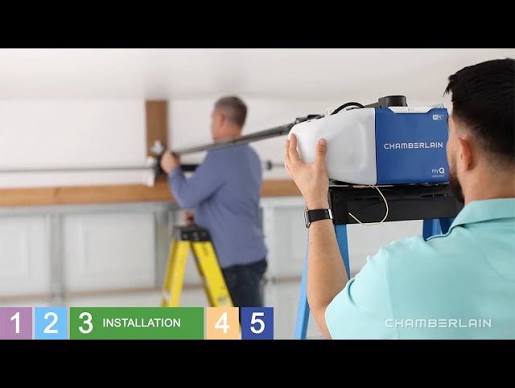
3. Mount the Motor Unit and Rail
Now, you need to position the heavy motor and rail assembly.
- Temporary Support: Use a stepladder or have a helper hold the motor unit.
- Connect to Header: Bolt the front of the rail to the header bracket you just installed.
- Attach to Angle Iron (Ceiling Mount): If you have a standard ceiling, you will likely need to attach the rear of the motor to angle iron hanging from the ceiling joists.
- Measure the distance from the motor to the ceiling joist.
- Cut angle iron to size and bolt it to the joist.
- Hang the motor from this angle iron using the provided U-bolts.
- Check Alignment: Use your level. The rail should be perfectly parallel to the garage door.
4. Attach the Belt and Tensioning
This step determines how smoothly your door operates.
- Loop the Belt: Wrap the belt around the motor sprocket and the idler pulley.
- Connect the Ends: Join the two ends of the belt using the provided connector hardware.
- Adjust Tension: This is crucial. The belt should be tight, but not guitar-string tight.
- The Rule of Thumb: The belt should have about 1/2 inch of deflection when you press down on it in the middle of the rail.
- Too loose: The door will jerk or slip.
- Too tight: You risk burning out the motor or snapping the belt.
5. Install the Door Arm and Bracket
The arm connects the moving carriage on the rail to the top of your garage door.
- Reinforce the Door: If your door is a single-layer steel or wood panel, you must install a reinforcement strut across the top section. This prevents the door from bending or breaking when the opener pulls it.
- Attach the Bracket: Bolt the door bracket to the center of the top door section.
- Connect the Arms: Attach the straight arm to the carriage and the curved arm to the door bracket. Connect them with a clevis pin and cotter pin.
6. Wire the Safety Sensors
Modern openers require photo-eye sensors to prevent the door from closing on a person or pet.
- Placement: Mount the sensors on both sides of the door track, approximately 6 inches off the floor.
- Alignment: The LED lights on both sensors must face each other. When aligned correctly, a steady light (usually green or amber) will illuminate. If they blink, they are misaligned.
- Run the Wire: Staple the low-voltage wire along the door track and up to the motor head. Keep the wire away from sharp edges and moving parts.
7. Electrical Connection and Programming
- Power Up: Plug the unit into a grounded outlet. If hardwiring, connect the black (hot) and white (neutral) wires to your junction box.
- Set Travel Limits: Most modern units have “Auto-Program” buttons. Press the button, and the door will travel up and down to learn its limits.
- Adjust Force: If the door reverses when hitting the floor, the “Down Force” may need a slight increase. Conversely, if it doesn’t reverse when hitting a 2×4 block on the ground, the force is too high (a safety hazard).
Expert Note: For more technical details on the history and mechanics of these systems, you can refer to the Garage Door Opener Wikipedia page.
Safety and Maintenance Tips
Installing the opener is only half the battle; maintaining it ensures longevity.
- Monthly Sensor Check: Wave a broom handle under the door while it closes. It should reverse immediately. If it doesn’t, clean the sensor lenses with a soft cloth.
- Lubrication: Unlike chain drives, do not oil the belt. However, you should lubricate the torsion springs and hinges with a silicone spray or white lithium grease once a year.
- Tighten Hardware: The vibration of the door can loosen bolts over time. Check the rail bolts and header bracket screws every six months.
FAQ Section
1. How long does it take to install a belt driven garage door opener?
For a DIYer with basic tools and experience, the installation typically takes 4 to 6 hours. If you are removing an old unit and disposing of it, add an extra hour. Professional installers can usually complete the job in 2 to 3 hours.
2. Can I install a garage door opener by myself?
Yes, most belt drive openers are designed for DIY installation. However, because you are working on a ladder and dealing with heavy components (the motor can weigh 20-30 lbs), having a second person to help lift and hold the rail is highly recommended for safety.
3. Is a belt drive opener worth the extra cost over a chain drive?
Absolutely. If your garage is attached to your house or located below a bedroom, the noise reduction is significant. Belt drives also tend to have less vibration, which reduces wear and tear on the door hardware and the structure of your home over time.
4. Why does my new belt drive opener sound “grinding”?
If you hear a grinding or humming noise but the door doesn’t move, the belt tension is likely too loose, causing the sprocket to slip against the belt. Alternatively, the plastic gears inside the motor (which act as a fail-safe) may have stripped if the door was obstructed. Check your tension first.
5. Do I need a reinforcement strut for my garage door?
Yes, if you have a sectional door made of single-layer steel, aluminum, or wood. Without a strut, the opener pulls from a single point in the center, which can crack or warp the top section of the door over time. The strut distributes the force across the entire width of the door.
Leave a Reply