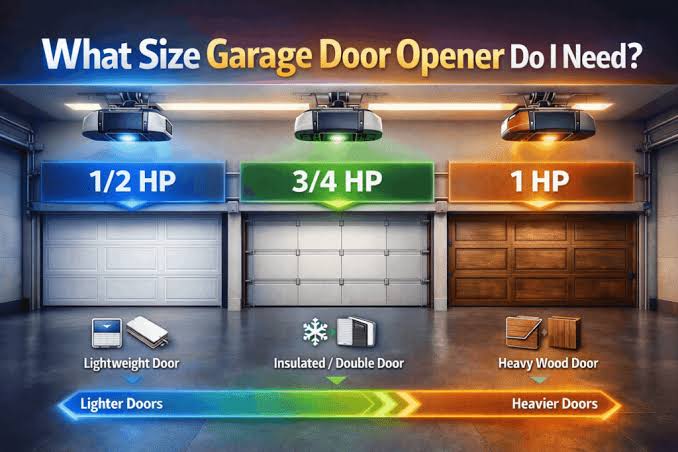
Choosing a new garage door opener can feel overwhelming when faced with technical specs and varying horsepower ratings. If you are wondering how to determine what size garage door opener you need, the answer lies in accurately matching your door’s weight, dimensions, and usage frequency to the motor’s capabilities. Selecting the wrong size isn’t just an inconvenience; it can lead to premature motor failure, safety hazards, and costly repairs down the road.
We understand that home maintenance is stressful enough without guessing games. This comprehensive guide will walk you through the exact measurements and calculations required to choose the perfect unit, ensuring your garage operates smoothly for years to come. Let’s get your door moving safely and efficiently.
Why Correct Sizing Matters for Safety and Longevity
Before diving into measurements, it is crucial to understand why “size” in this context refers to torque and lifting capacity rather than physical dimensions. A garage door opener that is too weak will strain its gears and overheat, while one that is excessively powerful for a lightweight door may cause unnecessary wear on springs and tracks.
According to industry standards, the lifespan of a properly sized opener averages 10–15 years. Conversely, an undersized unit operating at maximum capacity daily may fail in as little as 3–5 years. Proper sizing ensures:
- Safety Compliance: Adequate torque prevents the door from stalling mid-cycle, which can trigger auto-reverse sensors unpredictably.
- Energy Efficiency: Right-sized motors consume less electricity per cycle.
- Noise Reduction: Strained motors vibrate excessively; correctly sized units run quieter.
- Warranty Protection: Manufacturers often void warranties if improper sizing causes burnout.
Step-by-Step: Measuring Your Garage Door Accurately
You cannot determine the right opener without precise data. Grab a tape measure and follow these concrete steps. Do not estimate; accuracy within 0.5 inches matters.
1. Measure Door Height and Width
Standard residential doors are typically 7 or 8 feet high and 8, 9, or 16 feet wide. However, custom sizes exist.
- Height: Measure from the floor to the top of the door panel at three points (left, center, right). Use the largest measurement.
- Width: Measure the opening width at the bottom, middle, and top. Record the widest point.
2. Determine Door Weight (The Critical Metric)
Weight dictates horsepower requirements more than any other factor. If your door lacks a manufacturer sticker listing weight, calculate it:
- Single-Layer Steel: ~1.5 lbs per sq. ft.
- Double-Layer Steel: ~2.5 lbs per sq. ft.
- Triple-Layer/Insulated: ~3.5–4.0 lbs per sq. ft.
- Solid Wood: ~4.0–6.0 lbs per sq. ft.
Example Calculation: A 16×7 ft insulated steel door = 112 sq. ft. × 3.75 lbs = 420 lbs.
3. Assess Spring System Condition
Your opener lifts with the springs, not alone. If springs are worn, even a correctly sized opener will struggle. Have a professional inspect spring tension before installation. For deeper technical context on counterbalance mechanics, refer to Wikipedia’s Garage Door article, which explains torsion vs. extension spring physics.
Horsepower Guide: Matching Motor Power to Door Specs
Once you have your door’s weight, use this reference table to select appropriate horsepower (HP). Note that modern DC motors often use “lifting force” ratings alongside traditional AC HP equivalents.
| Door Type | Typical Weight Range | Recommended HP | Best Drive System |
|---|---|---|---|
| Single Car (Non-Insulated) | 90–130 lbs | ½ HP | Chain or Belt |
| Single Car (Insulated) | 140–180 lbs | ¾ HP | Belt Drive |
| Double Car (Non-Insulated) | 180–250 lbs | ¾ HP | Chain or Belt |
| Double Car (Insulated) | 260–350 lbs | 1¼ HP | Belt Drive |
| Custom/Wood/Carriage | 350–500+ lbs | 1¼–2 HP | Heavy-Duty Belt/Screw |
| Commercial/Light Comm. | 500+ lbs | 2+ HP / Jackshaft | Wall-Mount/Jackshaft |
Expert Tip: Always round up if your door weight falls between categories. The cost difference between ¾ HP and 1¼ HP is typically under $50, but the longevity gain is significant.
Choosing the Right Drive System for Your Home
Horsepower isn’t the only sizing consideration. The drive mechanism affects noise, maintenance, and suitability for specific installations.
Chain Drive
- Best For: Detached garages, heavy uninsulated doors, budget-conscious buyers.
- Pros: Most affordable, durable, handles extreme temperatures.
- Cons: Noisiest option; requires regular lubrication.
- Sizing Note: Ideal for doors >300 lbs where noise isn’t a concern.
Belt Drive
- Best For: Attached garages, bedrooms above garage, insulated doors.
- Pros: Whisper-quiet operation, minimal maintenance, smooth acceleration.
- Cons: Higher upfront cost; belts may need replacement after 10+ years.
- Sizing Note: Preferred for residential ¾–1¼ HP applications.
Screw Drive
- Best For: Wide doors, regions with stable temperatures.
- Pros: Fewer moving parts, faster opening speed.
- Cons: Sensitive to temperature fluctuations; louder than belt.
- Sizing Note: Less common today; verify local climate suitability.
Jackshaft (Wall-Mount)
- Best For: High ceilings (>10 ft), cathedral ceilings, limited headroom.
- Pros: Frees up ceiling space, ultra-quiet, integrates easily with smart systems.
- Cons: Most expensive; requires torsion spring system.
- Sizing Note: Rated by lifting force (e.g., 800N); ideal for custom/heavy doors.
Key Features That Complement Proper Sizing
A correctly sized opener should also include features that enhance performance based on your household needs:
- Battery Backup: Essential in storm-prone areas. Adds ~15 lbs to unit weight; ensure mounting hardware supports it.
- Smart Connectivity: Wi-Fi enabled openers allow remote monitoring. Verify your router signal reaches the garage; weak signals cause connectivity issues unrelated to motor size.
- Soft Start/Stop: Reduces mechanical stress by 30%, extending lifespan. Standard on most ¾ HP+ belt drives.
- Motion Detection Lighting: 200–300 lumens recommended for standard garages; higher for workshops.
Common Sizing Mistakes to Avoid
Even experienced DIYers make these errors. Double-check before purchasing:
- Ignoring Insulation Value: R-value adds weight. An R-16 door weighs significantly more than an R-8 equivalent.
- Overlooking Headroom: Low-headroom installations (<6 inches above door) require specialized low-profile openers regardless of HP.
- Assuming Bigger Is Better: A 2 HP opener on a 150 lb door causes excessive wear on rollers and hinges. Match, don’t exceed.
- Neglecting Rail Length: Standard rails fit 7–8 ft doors. Doors taller than 8 ft require extension kits; verify compatibility before buying.
- Skipping Professional Assessment: If your door has unique characteristics (custom wood, unusual track radius), consult a certified technician.
Frequently Asked Questions (FAQ)
Can I use a ½ HP opener for a double-car insulated garage door?
Generally, no. Most double-car insulated doors weigh 260–350 lbs, exceeding the safe operating range of ½ HP motors. Using an undersized unit risks motor burnout and unsafe operation. Upgrade to at least ¾ HP, preferably 1¼ HP for consistent performance and longevity.
Does garage door opener size depend on ceiling height?
Yes, indirectly. While ceiling height doesn’t change horsepower needs, it determines rail configuration and drive type. Ceilings above 10 ft often require jackshaft openers or extended rail kits. Standard ceiling-mount openers need minimum 2–3 inches clearance above the highest point of door travel. Measure carefully before selecting.
How do I know if my current opener is undersized?
Watch for these warning signs: frequent overheating shutdowns, slow opening/closing (>30 seconds), grinding noises, inability to fully close in cold weather, or tripping circuit breakers. If your door was replaced recently without upgrading the opener, the old unit is likely undersized for the new door’s weight.
Are DC motors better than AC motors for residential use?
For most homes, yes. DC motors offer variable speed control (soft start/stop), quieter operation, and battery backup compatibility. They’re rated differently (e.g., “750 Newtons” instead of HP) but generally outperform equivalent AC units. Reserve AC motors for extreme cold climates or commercial applications where simplicity trumps refinement.
What size opener do I need for a solid wood carriage house door?
Solid wood doors are exceptionally heavy (often 400–600 lbs). You’ll need a minimum 1¼ HP belt drive or dedicated jackshaft opener. Confirm exact weight with the door manufacturer first. Never assume standard residential openers suffice; carriage doors frequently require commercial-grade components.
Can I install a larger opener myself, or should I hire a pro?
If you’re replacing like-for-like with proper tools and experience, DIY is feasible. However, upsizing involves recalibrating safety sensors, adjusting travel limits, and verifying electrical load. Incorrect installation voids warranties and creates entrapment risks. We strongly recommend professional installation when changing HP ratings or drive types.
Final Thoughts: Invest Wisely for Decades of Reliability
Determining the correct garage door opener size isn’t about guesswork—it’s about respecting engineering principles and prioritizing safety. By accurately measuring your door, understanding weight-to-horsepower ratios, and selecting the appropriate drive system, you ensure reliable daily operation for 10+ years. Remember: the cheapest option upfront often costs more long-term through repairs and replacements.
Your garage door is likely the largest moving object in your home. Treat it with the precision it deserves. Take 20 minutes today to measure and calculate using this guide. Your future self—and your family’s safety—will thank you.
Found this guide helpful? Share it on Facebook, Pinterest, or Nextdoor to help neighbors avoid costly opener mistakes! Tag us with your installation photos—we love seeing successful projects. Safe lifting! 🏡🔧
Leave a Reply