Introduction
If you are noticing drafts, unusually high energy bills, or extreme temperatures in your garage, you might be asking yourself, “How do I know if my garage door is insulated?” You are not alone; millions of US homeowners face this exact dilemma, especially as seasonal weather extremes become more common. This comprehensive, beginner-friendly guide will walk you through simple, step-by-step methods to identify your door’s insulation status, helping you save money and improve your home’s overall comfort.
How Do I Know If My Garage Door Is Insulated? 5 Quick Checks
Figuring out your garage door’s insulation status does not require a professional inspection. You can perform these five simple checks yourself in under ten minutes.
1. The Visual Edge Test
Open your garage door and look closely at the top edge of the individual panels. If the door is insulated, you will typically see a distinct layer of foam material sandwiched between the inner and outer metal skins. Non-insulated doors usually reveal a hollow, single-layer metal interior.
2. The Knock Test
Gently tap on the interior surface of the garage door panels with your knuckles. An insulated door will produce a solid, muted “thud” due to the dense foam core absorbing the sound. Conversely, an uninsulated door will produce a hollow, echoing “clang.”
3. Check for an R-Value Label
Most reputable manufacturers stamp or stick a label on the inside edge or back of the door. This label explicitly states the door’s R-value, which is the industry standard for measuring thermal resistance.
4. The Temperature Touch Test
Wait for a day with extreme weather (either very hot or very cold). Place the back of your hand flat against the interior garage door panels. If the door feels close to the ambient room temperature of the garage, it is likely insulated. If it feels freezing cold in winter or radiating hot in summer, it is probably uninsulated.
5. Review the Model Number
Locate the manufacturer’s sticker, usually found on the back of the bottom panel or on the spring hardware. Search this model number online. The manufacturer’s specification sheet will explicitly state whether the door includes a polyurethane or polystyrene core.
Understanding Garage Door Insulation Types
Not all insulation is created equal. When evaluating your door, it is highly beneficial to know which of the two primary insulation materials it uses.
| Feature | Polyurethane Insulation | Polystyrene Insulation |
|---|---|---|
| Application | Injected as a liquid, expands to fill the entire panel cavity. | Pre-cut rigid foam boards inserted into the panel cavity. |
| Density & Strength | High density; bonds to the metal skin, increasing structural rigidity by up to 25%. | Lower density; provides basic thermal resistance but adds minimal structural strength. |
| Typical R-Value | R-12 to R-18 per panel (Higher efficiency). | R-4 to R-8 per panel (Moderate efficiency). |
| Cost | More expensive upfront, but offers better long-term energy savings. | More budget-friendly and common in entry-level insulated doors. |
Expert Insight: According to a study by the International Door Association (IDA), homeowners who upgrade to a high-R-value polyurethane garage door report an average 15% reduction in adjacent room heating and cooling costs, particularly when the garage shares a wall with the main living space.
Why Does Garage Door Insulation Matter?
Beyond just answering “how do I know if my garage door is insulated,” understanding the why is crucial for your home’s health.
- Energy Efficiency: The US Department of Energy (DOE) notes that an uninsulated garage can act as a massive thermal leak, forcing your HVAC system to work harder.
- Noise Reduction: Insulated doors dampen external noise (like traffic or lawn equipment) and prevent the loud “bang” of a closing door from echoing through your home.
- Durability: The internal foam core adds rigidity to the door panels, preventing dents and extending the lifespan of the hardware.
- Improved Comfort: If you use your garage as a workshop, gym, or storage area for temperature-sensitive items, insulation maintains a stable environment.
To truly understand how thermal resistance is measured, it is helpful to review the scientific principles behind the R-value (insulation), which dictates how well a material resists the conductive flow of heat.
Step-by-Step: How to Estimate Your Garage Door’s R-Value
If you cannot find a label, you can estimate the insulation quality using a simple physical measurement process.
Step 1: Gather Your Tools
You will need a standard retractable tape measure and a notepad.
Step 2: Measure Panel Thickness
Close the garage door. Measure the total thickness of a single horizontal panel from the outside skin to the inside skin.
- Concrete Detail: A standard non-insulated door is typically 1 3/8 inches thick. An insulated door will usually measure between 1 3/4 inches to 2 inches thick.
Step 3: Measure the Foam Core
If possible, look at the exposed edge of the panel (often visible at the very top section when the door is open). Measure the thickness of the foam itself.
- Concrete Detail: If the foam layer is at least 1 inch thick, it is likely polystyrene. If the panel is thick and the foam appears to be tightly bonded to both metal skins with no air gaps, it is likely injected polyurethane, indicating a higher R-value.
Step 4: Calculate the Temperature Differential
Use a digital infrared thermometer. Measure the outside surface temperature of the door, then immediately measure the inside surface temperature.
- Concrete Detail: On a day with a 15°F to 20°F difference between outside and inside ambient air, an insulated door will show a surface temperature difference of at least 5°F to 8°F between the exterior and interior panels. A non-insulated door will show nearly identical temperatures on both sides.
The Pros and Cons: Insulated vs. Non-Insulated Doors
✅ Pros of Insulated Garage Doors
- Lower monthly energy bills.
- Quieter operation and reduced street noise.
- Enhanced curb appeal (insulated doors often have more premium, raised-panel designs).
- Greater resistance to dents and dings.
❌ Cons of Insulated Garage Doors
- Higher initial purchase and installation cost (typically 15% to 30% more than non-insulated models).
- Heavier weight, which may require upgrading to a heavier-duty garage door opener (e.g., a 3/4 HP motor instead of a 1/2 HP).
✅ Pros of Non-Insulated Garage Doors
- Lower upfront cost, making them ideal for detached garages or mild climates.
- Lighter weight, putting less strain on existing springs and openers.
❌ Cons of Non-Insulated Garage Doors
- Poor temperature regulation.
- Prone to condensation and rust in humid climates.
- Noisier operation.
Frequently Asked Questions (FAQ)
Q1: Can I add insulation to an existing non-insulated garage door?
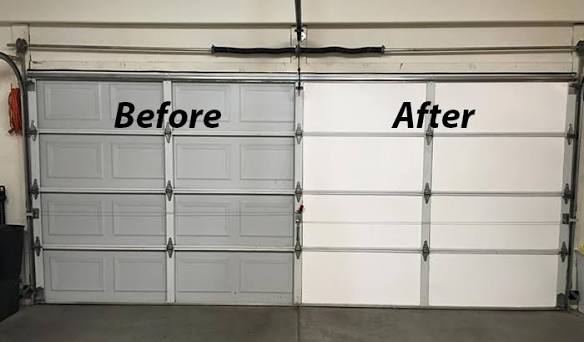
A: Yes, you can purchase aftermarket garage door insulation kits (usually reflective foil-backed foam boards). While they will not match the R-value of a factory-insulated polyurethane door, they can still improve thermal resistance by R-4 to R-8 and reduce noise. Ensure the added weight does not exceed your opener’s capacity.
Q2: What is a good R-value for a garage door?
A: For an attached garage, especially in regions with harsh winters or hot summers, an R-value of R-12 to R-18 is highly recommended. If your garage is detached and unheated, an R-value of R-4 to R-8 is generally sufficient.
Q3: Does an insulated garage door reduce noise?
A: Absolutely. The dense foam core acts as an acoustic barrier. Homeowners frequently report that insulated doors significantly reduce the sound of the door rolling on the tracks, as well as external noises like heavy rain, wind, or neighborhood traffic.
Q4: How much does it cost to replace a garage door with an insulated one?
A: In the US, a new insulated garage door typically costs between $1,200 and $4,000, including professional installation. The price varies based on size, material (steel, wood, or composite), and the specific R-value of the insulation.
Q5: Will an insulated garage door prevent my pipes from freezing?
A: It helps significantly, but it is not a standalone solution. An insulated door maintains a higher baseline temperature in the garage, reducing the risk of freezing. However, you should still properly insulate the pipes themselves and consider a small space heater if temperatures drop below 20°F for extended periods.
Conclusion
Knowing how do I know if my garage door is insulated is the first step toward a more comfortable, energy-efficient, and quieter home. By using the quick checks, understanding R-values, and recognizing the signs of polyurethane or polystyrene cores, you can make informed decisions about your property. Whether you choose to upgrade your current door with a DIY kit or invest in a brand-new, high-R-value model, the long-term benefits to your wallet and comfort are undeniable.
Found this guide helpful? Share it with your friends and neighbors on Facebook, Twitter, or Pinterest to help them tackle their home improvement projects with confidence!
Leave a Reply