Have you ever worried that a neighbor’s remote or a tech-savvy thief could accidentally—or intentionally—open your garage? It is a common concern among US homeowners who value their privacy and security. Many people ask, can you change the frequency on a garage door opener to prevent interference or enhance safety? The short answer is more complex than a simple yes or no, and understanding the technical limitations can save you time, money, and potential security risks.
Understanding How Garage Door Frequencies Work
To understand whether you can change the frequency, we first need to look at how these devices communicate. Garage door openers operate on specific radio frequencies (RF). In the United States, the most common frequencies are 315 MHz and 390 MHz. Older models may use 300 MHz or even 433 MHz, though the latter is more common in Europe and Asia.
The frequency is determined by the hardware inside both the remote control and the motor unit installed in your garage. Specifically, it relies on a small component called a crystal oscillator or a ceramic resonator. This component vibrates at a precise rate to generate the radio signal. Because this is a physical hardware component, it is not like changing a setting on your Wi-Fi router.
Why Hardware Limits Flexibility
Unlike software-based systems where you can update code to change parameters, garage door openers are built with fixed-frequency transmitters. If your remote is built for 315 MHz, it physically cannot transmit a 390 MHz signal without replacing the internal components. This is a crucial distinction for anyone hoping to simply “tune” their opener to a different channel to avoid interference.
For a deeper technical understanding of radio spectrum allocation, you can refer to Wikipedia’s article on Radio Spectrum, which explains how different bands are assigned for various uses, including consumer electronics.
Can You Physically Change the Frequency?
The direct answer to can you change the frequency on a garage door opener is: No, not without replacing major hardware components.
Here is why attempting to change the frequency manually is generally not feasible for the average homeowner:
- Fixed Crystals: As mentioned, the frequency is dictated by a crystal inside the circuit board. To change it, you would need to desolder the old crystal and solder in a new one of the exact correct frequency. This requires advanced electronics skills.
- Antenna Tuning: The antenna in both the remote and the motor unit is tuned to the specific wavelength of the original frequency. Changing the frequency without adjusting the antenna length will result in poor range or complete failure.
- Receiver Compatibility: Even if you managed to modify the remote, the motor unit’s receiver is also tuned to the original frequency. You would need to modify both devices simultaneously.
The Risk of DIY Modifications
Attempting to swap crystals or modify circuit boards can void your warranty and potentially damage the device. Moreover, transmitting on unauthorized frequencies can violate Federal Communications Commission (FCC) regulations in the US. It is far safer and more effective to work within the existing capabilities of your device.
Solving Interference Issues Without Changing Frequency
Most homeowners want to change the frequency because they are experiencing interference. Maybe your garage door opens when your neighbor uses their remote, or it fails to respond consistently. Instead of trying to change the frequency, consider these proven solutions.
1. Reprogram Your Remote Codes
Modern garage door openers use rolling codes or encrypted signals. Even if two neighbors have openers on the same frequency (e.g., 315 MHz), they should not interfere with each other if they are properly programmed.
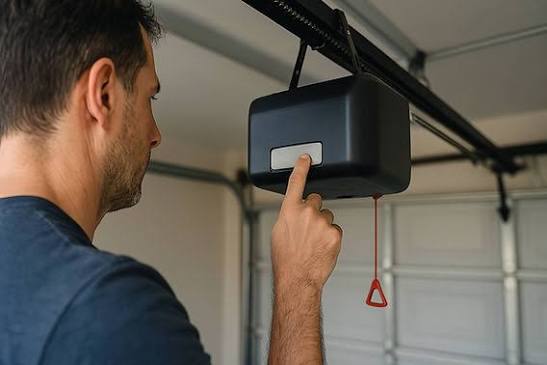
- Step 1: Locate the “Learn” button on your motor unit. It is usually colored yellow, purple, or red.
- Step 2: Press and hold the button until the indicator light blinks or turns off. This clears all existing codes.
- Step 3: Within 30 seconds, press the button on your remote control.
- Step 4: Test the door. Repeat for any additional remotes.
This process ensures your system is using a unique digital signature, reducing the chance of cross-interference.
2. Check for External RF Interference
Other devices can cause interference on the same frequency band. LED light bulbs, especially cheap ones, are notorious for emitting radio noise that disrupts garage door signals.
| Potential Interference Source | Solution |
|---|---|
| LED Bulbs in Garage | Replace with high-quality, FCC-compliant LEDs or incandescent bulbs. |
| Wi-Fi Routers | Move the router away from the garage door motor unit. |
| Baby Monitors | Ensure they are operating on a different band (e.g., 2.4 GHz vs 900 MHz). |
| Neighbors’ Remotes | Reprogram your system to refresh the rolling code sequence. |
3. Upgrade to a Smart Opener
If you frequently face interference, upgrading to a modern smart garage door opener might be the best long-term solution. Newer models often use dual-band frequencies or encrypted Wi-Fi connections, which are less susceptible to traditional RF interference.
Security Concerns: Is Your Frequency Safe?
A common myth is that changing the frequency makes your garage door more secure against hackers. In reality, frequency hopping is not a primary security feature in residential garage doors.
Rolling Code Technology
Since the mid-1990s, most reputable brands (like LiftMaster, Chamberlain, and Genie) have used rolling code technology. This means the code changes every time you press the button. Even if someone intercepts the signal, they cannot reuse it because the code has already expired.
- Old Fixed-Code Systems: These are vulnerable. If you have an opener with DIP switches (tiny toggle switches inside the remote), it is using a fixed code. These should be replaced immediately for security reasons.
- Modern Encrypted Systems: These are highly secure. Changing the frequency does not significantly enhance security because the encryption is the primary defense, not the frequency itself.
Expert Insight
According to security experts, physical security measures (like locking the interior door to your house) are more critical than worrying about RF frequency hacking. However, keeping your firmware updated and using strong, unique codes for smart openers is essential.
When to Replace Your Garage Door Opener
If you are asking can you change the frequency on a garage door opener because your current unit is old, unreliable, or lacks security features, replacement is often the most cost-effective option.
Consider replacing your opener if:
- It uses DIP switches (fixed codes).
- It operates on 300 MHz or lower (very old standard).
- You experience frequent interference despite troubleshooting.
- It is louder than 60 decibels (modern belt-drive models are much quieter).
Newer models offer features like battery backups, smartphone integration, and enhanced encryption protocols that older units simply cannot match.
FAQ Section
1. Can I change my garage door opener from 315 MHz to 390 MHz?
No, you cannot simply switch the frequency. The hardware components, including the crystal oscillator and antenna, are specifically designed for one frequency. To switch, you would need to replace both the remote controls and the motor unit’s logic board with compatible parts, which is usually more expensive than buying a new system.
2. Why does my garage door open when my neighbor uses theirs?
This is likely due to a code collision rather than a frequency issue. If both systems are old and use fixed codes, there is a small chance they share the same code. Reprogramming both systems to clear old codes and set new rolling codes usually solves this. If the problem persists, check for interfering LED lights.
3. Do all garage door openers in the US use the same frequency?
No, but most use either 315 MHz or 390 MHz. Some older models use 300 MHz, and some international brands may use 433 MHz. However, within the US market, 315 MHz is the most common standard for major brands like LiftMaster and Chamberlain.
4. Can I use a universal remote if I don’t know my frequency?
Yes, many universal remotes support multiple frequencies (e.g., 300, 315, and 390 MHz). You will need to follow the programming instructions to select the correct frequency for your specific opener model. Check your motor unit’s label for the frequency specification.
5. Is it legal to modify my garage door opener’s frequency?
Modifying the hardware to transmit on a frequency you are not licensed for can violate FCC regulations. Consumer garage door openers are certified to operate on specific bands. Unauthorized modifications could result in fines and interference with other critical services. It is always best to use certified equipment as intended.
6. How can I tell what frequency my garage door opener uses?
Check the label on the back of your remote control or on the motor unit in your garage. It will typically list the frequency in MHz (e.g., “315 MHz”). If the label is worn off, consult the user manual or search for your model number online.
Conclusion
So, can you change the frequency on a garage door opener? Technically, no—not without significant hardware modifications that are impractical and potentially illegal. However, you don’t need to change the frequency to solve most problems. By reprogramming your rolling codes, eliminating sources of RF interference like LED bulbs, and ensuring your system is up-to-date, you can achieve a secure and reliable garage door operation.
If your current system is outdated or causing persistent issues, investing in a modern smart opener is the best path forward. It offers better security, convenience, and peace of mind.
Found this guide helpful? Share it with your neighbors on Facebook or Twitter to help them secure their garages too! Stay safe and keep your home secure.
Leave a Reply