Introduction
Choosing the right motor for your garage can feel overwhelming, especially when technical specifications like horsepower (HP) start flying around. You just want a reliable system that opens your door smoothly without breaking the bank or failing after a year. Understanding the difference between a 1/2 HP or 3/4 HP garage door opener is the first step toward making a confident, long-lasting investment for your home.
Many homeowners assume that “more power is always better,” but this isn’t necessarily true for every situation. An oversized motor can be unnecessarily expensive and noisy, while an undersized one may struggle with heavy wooden doors or frequent use. In this guide, we will break down exactly what these ratings mean, how to calculate your needs, and which option provides the best value for your specific setup.
What Does Horsepower Mean in Garage Door Openers?
Before diving into the comparison, it is crucial to understand what “horsepower” actually signifies in this context. Unlike cars, where HP relates to speed and acceleration, in garage door openers, it refers to torque—the rotational force required to lift the weight of your door.
Standard residential garage door openers typically range from 1/3 HP to 1+ HP. However, the two most common contenders for average to heavy-duty homes are the 1/2 HP and 3/4 HP models.
- 1/2 HP: Considered the standard for most single-car and lighter double-car garage doors.
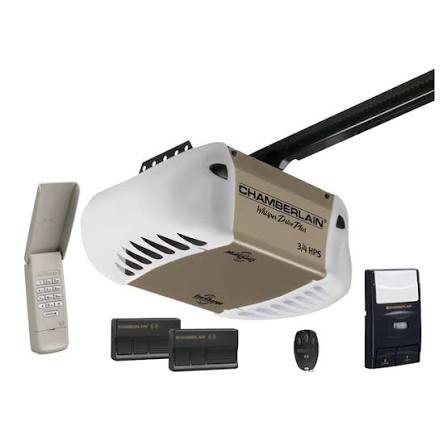
- 3/4 HP: Designed for heavier doors, frequent use, or larger double-car setups.
According to industry standards, the horsepower rating helps determine the longevity of the motor under load. A motor working near its maximum capacity will wear out faster than one operating comfortably within its limits.
1/2 HP Garage Door Opener: The Standard Choice
The 1/2 HP motor is the workhorse of the residential garage industry. It has been the default recommendation for decades for good reason: it offers a perfect balance of power, price, and efficiency for the majority of American homes.
Ideal Use Cases
A 1/2 HP opener is generally sufficient for:
- Single-car garage doors.
- Double-car garage doors made of lightweight materials (aluminum, thin steel, or fiberglass).
- Doors that are well-balanced and maintained.
- Homes where the garage is used primarily for storage rather than daily vehicle entry/exit.
Pros and Cons
| Feature | Details |
|---|---|
| Cost | More affordable; typically $50–$100 cheaper than 3/4 HP models. |
| Noise Level | Generally quieter if paired with a belt-drive system. |
| Installation | Easier to handle due to lighter motor weight. |
| Limitation | May struggle with solid wood doors or poorly balanced springs. |
If your garage door is made of standard insulated steel panels and weighs under 350 pounds, a 1/2 HP unit will likely serve you well for 10–15 years.
3/4 HP Garage Door Opener: The Heavy-Duty Solution
As garage doors have become larger, more insulated, and aesthetically complex (think carriage-house styles with windows), the demand for more powerful motors has risen. The 3/4 HP opener is engineered to handle these increased loads with ease.
Ideal Use Cases
You should strongly consider a 3/4 HP opener if:
- You have a double-car garage door wider than 16 feet.
- Your door is made of heavy materials like solid wood, thick steel, or composite.
- The door has multiple windows, adding significant weight.
- You use the garage door frequently (more than 3–4 times per day).
- You live in an area with extreme temperatures, causing metal tracks to expand/contract and increase friction.
Why Extra Power Matters
A 3/4 HP motor doesn’t just lift heavier doors; it lifts any door with less strain. This reduced strain translates to:
- Longer Motor Life: The motor isn’t working at its peak capacity, reducing heat buildup and wear.
- Smoother Operation: Less vibration and jerking during startup and shutdown.
- Better Performance with Accessories: If you plan to add smart home integrations or battery backups, the extra power headroom ensures consistent performance.
Key Comparison: 1/2 HP vs 3/4 HP
To help you visualize the differences, here is a direct comparison based on critical factors for US homeowners.
1. Weight Capacity
- 1/2 HP: Best for doors weighing up to 350–400 lbs.
- 3/4 HP: Capable of lifting doors weighing 400–600+ lbs.
2. Price Difference
While prices vary by brand (Chamberlain, LiftMaster, Genie, etc.), expect to pay a premium for the higher horsepower. On average, a 3/4 HP model costs 15–20% more than its 1/2 HP counterpart. However, this cost is often negligible compared to the expense of replacing a burnt-out motor prematurely.
3. Noise Levels
Contrary to popular belief, horsepower does not directly dictate noise. The drive type is the primary factor:
- Chain Drive: Noisy, regardless of HP.
- Belt Drive: Quiet, regardless of HP.
- Screw Drive: Moderate noise, durable.
However, a 3/4 HP motor running a heavy door may sound smoother because it isn’t straining, whereas a 1/2 HP motor might groan under the same load.
4. Energy Efficiency
Modern openers are highly efficient. The difference in electricity consumption between 1/2 HP and 3/4 HP is minimal for residential use. Both types consume very little power when idle and only draw significant current during the few seconds of operation.
How to Choose the Right HP for Your Door
Not sure which category your door falls into? Follow this simple decision framework.
Step 1: Identify Your Door Material
- Aluminum/Thin Steel: Go with 1/2 HP.
- Insulated Steel (Standard): 1/2 HP is usually fine, but 3/4 HP adds longevity.
- Solid Wood/Heavy Composite: Definitely choose 3/4 HP.
Step 2: Check the Door Size
- Single Car (8×7 or 9×7 ft): 1/2 HP is sufficient.
- Double Car (16×7 ft): 1/2 HP works for light doors; 3/4 HP is recommended for standard/heavy doors.
- Oversized (18×7 ft or taller): Always go with 3/4 HP or higher.
Step 3: Evaluate Usage Frequency
If you work from home and enter/exit the garage multiple times a day, or if you have teenagers who forget to close the door, the extra durability of a 3/4 HP motor is worth the investment. Frequent cycling generates heat; a larger motor dissipates heat better.
Step 4: Consider Future Proofing
Are you planning to insulate your existing door? Adding insulation kits can add 50–100 lbs to your door. If you are on the borderline, opting for the 3/4 HP now saves you from upgrading later.
For more detailed technical specifications on garage door weights and materials, you can refer to general construction standards on Wikipedia.
Common Myths About Garage Door Horsepower
Myth 1: “Higher HP means faster opening.” Fact: Most residential openers operate at similar speeds (typically 7–8 inches per second). HP affects lifting capability, not speed.
Myth 2: “I need 1 HP for a double door.” Fact: For 99% of residential homes, 1 HP is overkill. A 3/4 HP unit is more than capable of handling even heavy double doors. Save the 1 HP+ models for commercial industrial doors.
Myth 3: “All 1/2 HP openers are the same.” Fact: Quality varies significantly between brands. A high-end 1/2 HP belt-drive from a reputable brand may outperform a cheap 3/4 HP chain-drive in terms of smoothness and longevity.
FAQ Section
Q1: Can I upgrade from a 1/2 HP to a 3/4 HP opener later?
Yes, you can. However, you may need to adjust or replace the torsion springs on your door. Springs are calibrated to counterbalance the door’s weight. If the new opener has different lifting characteristics, a professional technician should rebalance the system to prevent premature wear.
Q2: Is a 3/4 HP opener louder than a 1/2 HP?
Not necessarily. Noise is primarily determined by the drive mechanism (chain vs. belt). A 3/4 HP belt-drive opener will be much quieter than a 1/2 HP chain-drive opener. In fact, because the 3/4 HP motor strains less, it may operate more smoothly and quietly under heavy loads.
Q3: Will a 1/2 HP opener damage my heavy door?
It won’t immediately “damage” it, but it will struggle. This struggle leads to overheating, tripped safety sensors, and eventual motor burnout. Additionally, the strain can put excess pressure on the gears and sprockets, leading to costly repairs down the line.
Q4: Do smart features require a specific horsepower?
No. Smart connectivity (Wi-Fi, app control) is independent of motor power. You can find smart-enabled openers in both 1/2 HP and 3/4 HP variants. However, ensure the opener has a battery backup if you want smart features to work during power outages.
Q5: What is the lifespan difference between 1/2 HP and 3/4 HP?
If used within their intended weight limits, both can last 10–15 years. However, if a 1/2 HP motor is consistently asked to lift a door near its maximum capacity, its lifespan may drop to 7–10 years. A 3/4 HP motor lifting the same door will likely last longer because it operates with less stress.
Conclusion
Deciding between a 1/2 HP or 3/4 HP garage door opener ultimately comes down to matching the motor to your door’s weight and your usage habits. For most standard, lightweight single or double doors, the 1/2 HP model remains a cost-effective and reliable choice. However, if you have a heavy wooden door, an oversized entrance, or high-frequency usage, the 3/4 HP model offers superior durability, smoother operation, and peace of mind.
Don’t guess when it comes to your home’s security and convenience. Assess your door’s material and weight, consider how often you use it, and choose the power that ensures smooth sailing for years to come.
Found this guide helpful? Share it with your neighbors on Facebook or Pinterest who might be struggling with their noisy or sluggish garage doors! Let’s help everyone enjoy a smoother ride in and out of their garages.
Leave a Reply