Introduction
There is nothing quite as frustrating as pressing your garage door opener and hearing a loud bang followed by silence. Or perhaps the door simply refuses to budge, leaving your car trapped inside. If you are staring at a stuck door and wondering how to tell if your garage door spring is broken, you are not alone. This is one of the most common household maintenance issues in the United States, affecting millions of homeowners every year.
In this guide, we will walk you through the exact symptoms of a failed spring, explain the difference between the two main types, and provide crucial safety advice. Remember, garage door springs are under extreme tension. While understanding the problem is easy, fixing it requires professional expertise. Let’s dive in to help you diagnose the issue safely and accurately.
Why Do Garage Door Springs Break?
Before we identify the signs, it helps to understand why this happens. A garage door is heavy—typically weighing between 130 and 400 pounds. The springs do not actually “lift” the door; they counterbalance the weight so the motor (or your arms) can move it with minimal effort.
Every time you open and close your door, the springs undergo a cycle of twisting (torsion) or stretching (extension). Like any metal component subjected to constant stress, they eventually suffer from metal fatigue.
According to industry standards, most residential garage door springs are rated for approximately 10,000 cycles. If you use your garage door four times a day, a standard spring should last about seven years. However, factors like extreme temperature fluctuations, lack of lubrication, and poor installation can significantly shorten this lifespan.
Sign #1: The Loud “Bang” or Gunshot Sound
The most immediate and alarming indicator of a broken spring is noise. When a high-tension spring snaps, it releases energy instantaneously.
- What it sounds like: Many homeowners describe it as sounding like a gunshot, a firecracker, or a loud thunderclap.
- When it happens: This usually occurs while the door is in motion (either opening or closing).
- Immediate Action: If you hear this sound, stop using the door immediately. Do not attempt to force it open or closed.
While other components like cables or rollers can make noise, a singular, sharp bang is almost exclusively associated with a spring failure.
Sign #2: The Door Won’t Open (Or Opens Only Partially)
If your garage door opener motor is running, but the door stays put, the spring is likely the culprit. Without the counterbalance provided by the spring, the electric motor does not have enough torque to lift the heavy door panels.
Check these scenarios:
- Complete Failure: The motor hums, but the door does not move an inch.
- Partial Opening: The door opens a few inches or a foot and then stops. This often happens if one spring in a dual-spring system has broken, leaving the other to struggle with the full weight.
- Manual Test: Pull the emergency release cord (the red handle) to disconnect the opener. Try to lift the door manually. If it feels incredibly heavy—like lifting a solid block of concrete—the springs are not providing assistance. A properly balanced door should lift smoothly with moderate effort.
Sign #3: Visible Gaps in Torsion Springs
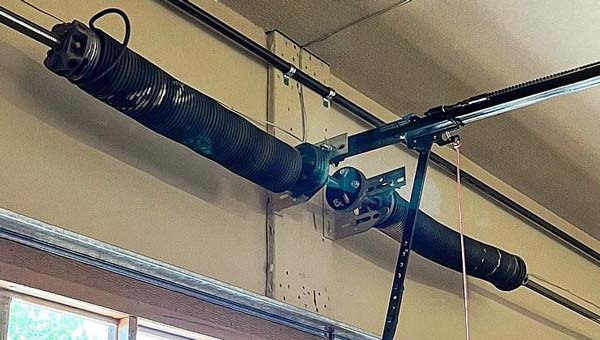
For most modern homes, the springs are located above the door header. These are called torsion springs. They look like thick metal coils wrapped around a steel shaft.
To inspect them safely:
- Stand outside the garage or just inside the threshold.
- Look up at the horizontal bar above the door.
- Check the coils closely.
What to look for: A healthy torsion spring will have tight, uniform coils with no space between them. If a spring is broken, you will see a clear gap in the coil where the metal has snapped. Sometimes, the two ends of the broken spring will be separated by several inches.
Safety Warning: Never touch, poke, or try to manipulate a torsion spring. Even a broken spring can retain dangerous levels of tension.
Sign #4: Crooked or Uneven Door Movement
If your garage door uses extension springs (located on both sides of the upper tracks), the signs might be subtler initially. Extension springs stretch out when the door is closed and contract when it opens.
If one extension spring breaks:
- The door may appear crooked or tilted as it moves.
- One side of the door may hang lower than the other.
- You might see a loose cable hanging down near the track on the side of the broken spring.
This imbalance puts severe strain on the rollers, tracks, and the opener itself. Continuing to operate a crooked door can lead to costly secondary damage, such as bent tracks or derailed rollers.
Sign #5: The Opener Strains or Reverses Immediately
Modern garage door openers are equipped with safety sensors and force settings. If the springs are broken, the opener detects excessive resistance.
- Straining Noise: You may hear the motor groaning or working much harder than usual.
- Auto-Reverse: The door starts to open, hits resistance due to the lack of spring support, and immediately reverses back down. This is a safety feature preventing the motor from burning out or the door from crashing.
If your door was working fine yesterday but now reverses immediately upon opening, check the springs before adjusting the force settings on your opener. Adjusting the force without fixing the spring is a temporary fix that risks damaging your opener.
Torsion vs. Extension Springs: Knowing the Difference
Understanding which type of spring you have helps in diagnosis and communication with repair technicians.
| Feature | Torsion Springs | Extension Springs |
|---|---|---|
| Location | Mounted horizontally above the door header. | Mounted vertically along the horizontal tracks on both sides. |
| Appearance | Tight metal coils on a central shaft. | Long springs that stretch and contract with pulleys/cables. |
| Lifespan | Generally longer (15,000–20,000 cycles available). | Shorter lifespan (typically 10,000 cycles). |
| Safety | Safer if contained in a tube; high tension risk. | Higher risk of snapping violently if safety cables are missing. |
| Cost | Slightly more expensive to replace. | Generally cheaper parts, but labor varies. |
For more detailed technical specifications on garage door mechanisms, you can refer to general engineering principles found on Wikipedia’s page on Garage Doors.
⚠️ Critical Safety Warning: Do Not DIY This Repair
It cannot be stressed enough: Replacing a garage door spring is not a typical DIY project.
Garage door torsion springs are wound under immense pressure—often over 200 pounds of torque. If a winding bar slips or a clamp fails during replacement, the spring can unwind explosively. This can cause:
- Severe hand or finger injuries.
- Facial injuries from flying metal fragments.
- Property damage to vehicles or stored items.
According to the Consumer Product Safety Commission (CPSC), thousands of injuries related to garage doors occur annually, with spring-related accidents being among the most severe. Always hire a licensed and insured garage door technician. They have the specialized tools (winding bars, vice grips, and clamps) and training to perform the job safely.
FAQ: Common Questions About Broken Garage Door Springs
1. Can I still use my garage door if the spring is broken?
No. You should not attempt to open or close the door. Operating the door without functional springs places the entire weight on the opener motor, which will likely burn out. Additionally, the door could fall unexpectedly, causing injury or damage.
2. How much does it cost to replace a garage door spring?
The cost varies based on location, spring type, and door weight. On average, homeowners in the US pay between $150 and $350 for professional replacement. This usually includes parts, labor, and a safety inspection. Dual-spring systems will cost more than single-spring setups.
3. How long do garage door springs last?
Standard springs are rated for 10,000 cycles. With average use (4 cycles per day), this equals about 7 years. High-cycle springs rated for 25,000+ cycles are available and can last 15–20 years, making them a worthwhile investment if you plan to stay in your home long-term.
4. Can I replace just one spring if I have two?
If your door has two torsion springs and only one breaks, it is highly recommended to replace both. Since they were installed at the same time, the second spring is likely near the end of its life cycle as well. Replacing both ensures balanced operation and saves you from another service call in the near future.
5. What causes garage door springs to break prematurely?
Lack of maintenance is the primary cause. Springs need periodic lubrication with a silicone-based or lithium-based grease to reduce friction. Additionally, extreme cold weather can make metal brittle, and poor initial installation (incorrect wind count) can lead to early failure.
6. Is there a way to prevent spring breakage?
While you cannot stop metal fatigue entirely, you can extend the life of your springs. Lubricate them every six months, keep the tracks clean, and ensure the door is properly balanced. If you notice the door becoming heavier to lift manually, call a professional for an adjustment before the spring snaps.
Conclusion
Knowing how to tell if your garage door spring is broken can save you time, money, and potential injury. By listening for loud bangs, checking for visible gaps in the coils, and testing the door’s balance, you can quickly diagnose the issue.
Remember, a broken spring is a safety hazard, not just an inconvenience. Do not attempt to force the door or repair the springs yourself. Instead, contact a qualified garage door specialist who can replace the springs safely and ensure your door is balanced correctly.
Found this guide helpful? Share it with your neighbors or on social media to help others stay safe and informed about their home maintenance!
Leave a Reply